Angle Converter
Try Angle Converter
Loading calculator. If this message stays visible, enable JavaScript and reload.
Your result
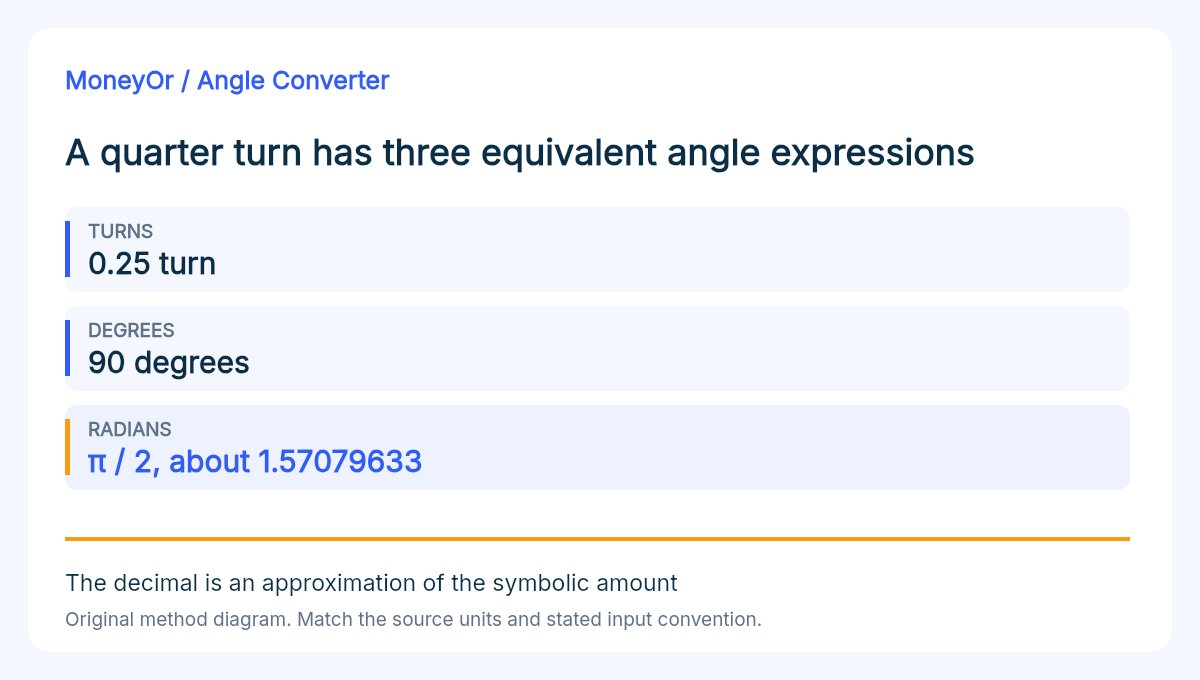
The angle converter changes a numeric angle between degrees, radians and turns. Enter the amount, select its original unit and choose the desired result. A quarter turn converts to 90 degrees, and 180 degrees displays as about 3.14159265 radians.
The result keeps the original rotation amount and its sign. Enter 1.5 turns and the degree result is 540 degrees. If your work needs a single equivalent angle in a specified range, reduce the rotation separately. If a source gives degrees, minutes and seconds, combine them into decimal degrees first.
On this page
- Angle Converter degrees, radians and turns
- Angle Converter rotation amount inputs
- Angle Converter degree and radian factors
- Angle Converter checked angle examples
- How can you convert degrees, arcminutes and arcseconds first?
- Does changing units wrap an angle into one turn?
- When do angular rates or trigonometric calculations need another step?
- How do you save a converted angle at the right precision?
- Frequently asked questions
- Sources
How to use the Angle Converter
Angle Converter degrees, radians and turns
The angle converter provides degrees, radians and turns in both menus. In this context a turn means one complete rotation. The same rotation spans 360 degrees or 2π radians. The form changes the scale of a numeric amount while leaving its sign and number of rotations intact.
A degree is one 360th of a complete turn. One radian is the central angle whose arc length is equal to the radius. For a circular arc, the ratio of arc length to radius gives the angle in radians when both lengths use the same unit. OpenStax’s chapter on angles explains how this definition relates to a full rotation. Use the ratio calculator to simplify two whole-number measurements first. An arc of 12 cm on a 4 cm radius gives 3 radians.
Turns are convenient when the source directly describes fractions or counts of rotations. An instruction may specify half a turn. A geometry problem may state the same angle as 180 degrees. A trigonometric calculation may use the equivalent π radians. Check the input convention required by the destination.
The selectors describe angular amounts. A value in degrees per second or rotations per minute has a time denominator and needs a separate rate conversion. A geographic coordinate, a compass bearing and a phase reading can also have their own sign, direction and reference conventions.
Forms of notation such as arcminutes, arcseconds, gradians and expressions containing π are outside the available numeric unit choices. Prepare a decimal amount in a supported unit before using the page.
Angle Converter rotation amount inputs
Put the number in Amount. Choose degrees, radians or turns under From unit to match the amount as given, then select the wanted scale in To unit. Choose Calculate / Run. Read the scale attached to the answer and compare the one-unit relationship shown on the factor line.
For two and a quarter turns, type 2.25 and choose turns to degrees. The result is 810 degrees. If the source gives a fraction such as a quarter turn, enter 0.25. The numeric field needs an amount without unit symbols or written arithmetic.
If the source uses π radians exactly and you need the degree equivalent at ordinary display precision, enter a decimal approximation of π. Keep the exact expression in your notes. If you start from 180 degrees, the Angle Converter returns a decimal result in radians instead of displaying π as a symbol.
Use a minus sign if the source specifies a negative rotation. The unit factors are positive. For instance, -0.5 turn converts to -180 degrees. If the task defines a particular clockwise or counterclockwise convention, write that convention down as part of the result.
Selecting the same unit on both sides uses a factor of one. This can help you check the numeric entry before converting it to a different scale.
Angle Converter degree and radian factors
A circle has circumference 2π times its radius. In radian measure, a full rotation therefore spans 2π radians. Equating that rotation to 360 degrees gives π radians per 180 degrees, or 180 degrees per π radians. The conversion uses these fixed geometric relationships.
| Source unit | Degrees per unit | Useful reference |
|---|---|---|
| degrees | 1 | 180 degrees is a half-turn |
| radians | 180 ÷ π | π radians is a half-turn |
| turns | 360 | 0.5 turn is a half-turn |
The Angle Converter multiplies the amount by the degrees per source unit, then divides by the degrees per target unit. To go from degrees to radians, the direct multiplier is π ÷ 180. For turns to radians, multiply by 2π. An equivalent conversion through degrees gives the same geometric relationship.
In a worksheet, preserve a symbol such as π/4 if the question asks for an exact radian answer. A numeric result of 0.78539816 is that angle to eight decimal places. Exact notation and a formatted decimal serve different uses. Keep enough precision for any follow-up calculation and round at its final step.
For a reverse check, the basic calculator can evaluate an explicitly written numeric factor. Use a sufficiently precise decimal value of π when entering one, and label the input and output units in your notes.
Angle Converter checked angle examples
Check one whole-turn relationship, a fraction, a case with a longer decimal and a signed rotation. Use the result unit as part of the expected answer, because the same number in different angle units usually describes a different rotation.
| Enter | To unit | Expected display | Arithmetic check |
|---|---|---|---|
| 0.25 turns | degrees | 90 degrees | 0.25 × 360 |
| 180 degrees | radians | 3.14159265 radians | One π radian amount |
| 1 radian | degrees | 57.29577951 degrees | 180 ÷ π |
| 2.25 turns | degrees | 810 degrees | 2.25 × 360 |
| 540 degrees | turns | 1.5 turns | 540 ÷ 360 |
| -0.5 turns | degrees | -180 degrees | -0.5 × 360 |
| 45 degrees | radians | 0.78539816 radians | π ÷ 4 |
The decimal radian results are display approximations. If you re-enter 3.14159265 radians and ask for degrees, the answer can differ slightly from 180 degrees. That difference comes from reusing a rounded number as an exact input. Compare using the original amount or the symbolic form when exactness matters.
For a sanity check, one radian is a little less than 60 degrees. One degree is under a tenth of a radian. A large discrepancy in a simple test like these usually points to a switched source and target or a copied unit label from an adjacent column.
How can you convert degrees, arcminutes and arcseconds first?
A degree contains 60 arcminutes and an arcminute contains 60 arcseconds. For a positive angle, add the whole degrees, the arcminutes divided by 60 and the arcseconds divided by 3,600. The result is a single number in decimal degrees. Use the decimal degrees result as Amount and choose degrees as From unit.
For example, 17 degrees, 24 arcminutes and 18 arcseconds gives 17 + 24 ÷ 60 + 18 ÷ 3,600 = 17.405 degrees. The small prime and double-prime marks can look like time notation. For arcs or coordinates, the parts divide an angle. The time unit converter handles time minutes and seconds as a separate quantity.

With a sign-magnitude DMS convention, apply the sign to the combined angular amount. Under that convention, -7 degrees and 30 arcminutes is -7.5 degrees. Check how a specific source handles its sign or a hemisphere letter. Coordinate documents can state a direction separately.
The Angle Converter has no separate minutes, seconds or hemisphere controls. It also does not interpret map positions. If you are preparing latitude and longitude, preserve the identity and sign of each coordinate and follow the source coordinate convention before converting either amount.
A common transcription error is to write 17.2418 into a decimal field for 17 degrees, 24 arcminutes and 18 arcseconds. That groups the digits from the three fields without applying their different denominators.
Does changing units wrap an angle into one turn?
The calculation scales the entire input. An amount of 540 degrees becomes 1.5 turns. An equivalent orientation can be expressed as 180 degrees if your application wants an angle between 0 degrees inclusive and 360 degrees exclusive. Reducing the angle to that range is a separate operation.

Check which interval the receiving program uses. A signed range centred around zero and a nonnegative one-turn range can represent the same orientation with different numbers. When an orientation lies on a boundary, the specified endpoint rule determines which representation to use.
When comparing rotation distance, retain full turns instead of reducing them. A turn-and-a-half movement ends at the same direction as a half turn, but the travelled angular amount is different. A controller log or measurement worksheet may need the accumulated amount.
For a negative angle, the conversion keeps the negative result on the new scale. Any interpretation as a bearing or direction must account for the reference direction and sign convention from the source. The Angle Converter applies no compass normalization and does not infer a reference axis.
Before copying a result, ask whether your destination needs the movement itself or just the final orientation. Record any normalization you apply so the conversion remains reproducible.
For example, two readings of 355 degrees and 5 degrees appear 350 degrees apart if you subtract the numbers in that order. Along the shorter path around a circle they are separated by 10 degrees, provided both use the same reference. Determining that shorter separation involves a choice about how to compare orientations. The linear conversion factors on this page do not determine that choice.
When do angular rates or trigonometric calculations need another step?
An angular rate contains both an angle and a time. For an amount described in degrees per second, convert the angle scale and keep the per-second denominator unchanged if the time unit stays the same. If both scales change, apply the time conversion separately.
A repeating process can also use frequency in hertz, which counts cycles per second. The frequency unit converter changes the prefix on a known frequency. To relate a cycle rate to an angular rate in radians per second, account for 2π radians per full cycle where the process defines the cycle that way.
For a trigonometric function, match the angle unit expected by the receiving system. A worksheet may use radians for its sine and cosine functions. A classroom calculator can have an angle mode setting. The Angle Converter gives numeric angle equivalents and has no trigonometric function input.
To find the length of a circular arc, obtain the radius and the angle in radians. The arc length is radius times the angle magnitude in radians. Use the length converter when the radius or resulting length needs a supported unit change. Write the two calculations separately in your notes.
In a diagram of a circular track with a radius of two metres, a quarter turn subtends an arc of π metres. Convert the quarter turn to π/2 radians, then multiply by two metres. Taking a quarter of the circumference gives the same result. Multiplying the radius by 90 degrees would skip the factor that links degree measure to the geometric arc relationship.
Percent grade is another quantity sometimes confused with degrees. Grade describes rise compared with horizontal run under a stated convention. A slope angle comes from an inverse trigonometric relationship with that ratio. Convert the resulting angle once its unit is known.
How do you save a converted angle at the right precision?
Keep the original amount and unit beside the converted form. A decimal approximation of an exact radian expression can be useful when a system needs a number. Preserve the exact expression separately for drawings, proofs or other work where symbolic precision matters.
Copy result includes the numeric answer and the factor detail. Download CSV creates a result file. If the angle represents a position or movement in a larger system, record the axis, direction and reference convention separately. The Angle Converter has no field for those details.
Save as baseline stores the displayed value during the page session. Compare later values on the same target scale and with the same normalization convention. A baseline of 180 degrees and a result of about 3.14159265 radians can describe the same rotation. Reset fields clears the active result and baseline.
The calculation runs in the browser using the amount and unit choices. Enter the numerical angle you need, and keep the rest of your diagram or data in its original source. Round your final output according to the needs of that source or the calculation that follows.
Frequently asked questions
What is a quarter turn in radians?
A quarter turn is π divided by two radians. Enter 0.25 turns and select radians for a decimal result. The corresponding degree amount is 90 degrees.
Can I type a π expression in Amount?
Amount needs a numeric value. Use a decimal approximation or enter an equivalent angle in degrees or turns. Keep the symbolic form separately if your work requires it.
Is a turn the same as a revolution?
For an angular amount, one full turn corresponds to one complete revolution. For a rate in revolutions per minute, the per-minute part requires separate handling.
Does converting to radians change a negative angle?
The negative sign stays negative. The scale changes according to the positive factor. Keep the original axis and direction convention when reusing the converted number.
Can the form calculate the angle between two lines?
The Angle Converter starts from an existing angle amount. First calculate the angle from the geometry or coordinates with the method suited to your problem, then convert it here.
How can I express an angle to fewer decimal places?
Round a copy of the displayed result to the precision your task requires. Keep the unrounded input for replay and avoid repeated conversions of rounded copies.
Sources
- OpenStax: Precalculus 2e, 5.1 Angles. Reference checked 26 November 2026.
- NIST: Guide to the SI, Appendix B.9 Factors by Kind of Quantity. Reference checked 26 November 2026.