Combination Calculator
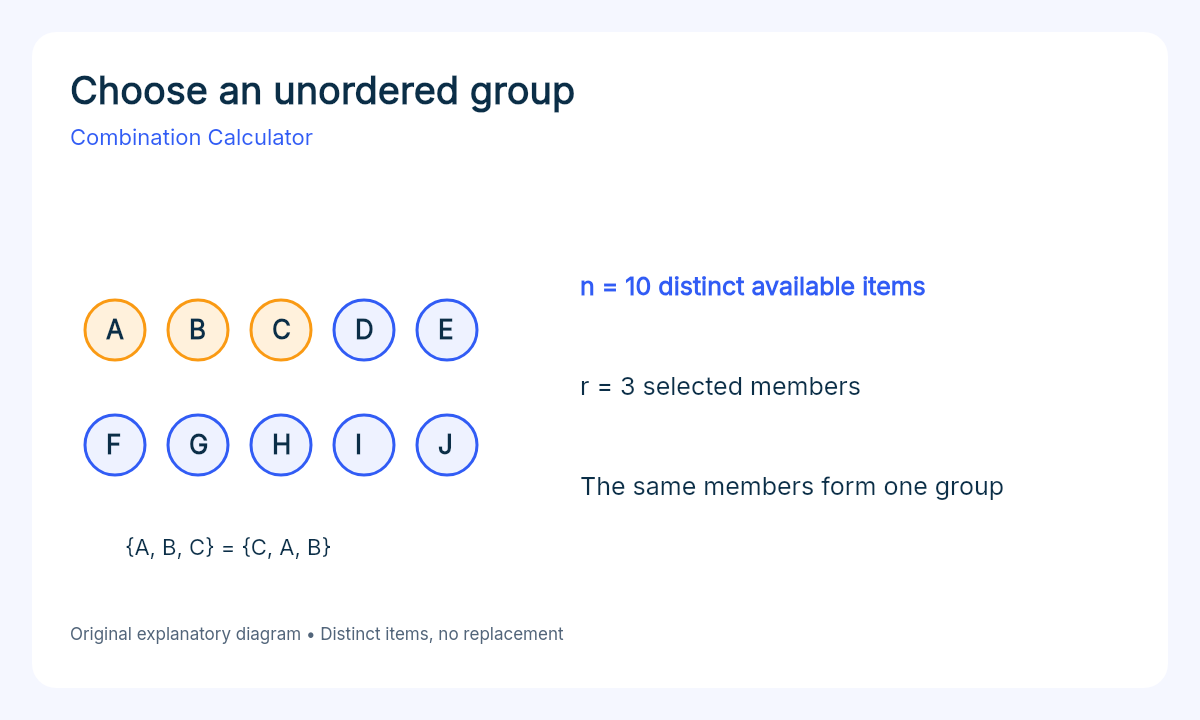
This combination calculator counts unordered selections of distinct items chosen without replacement. Enter the number of available items as n and the number to choose as r. With 10 distinct items and a group size of 3, there are 120 possible groups. Rearranging the same three members does not create another combination.
Loading calculator. JavaScript is required.
Your result
Use the combination calculator when the selected set matters but its internal order does not. Topics A, B and C form the same shortlist as C, A and B. If those topics instead fill three numbered presentation slots, their order matters and a permutation model is the appropriate counting approach. Extra selection restrictions are not inferred from n and r.
On this page
How to use the combination calculator
Count the distinct available items and enter that whole number as n. Enter the required group size as r. The supported range is 0 through 170, with r no larger than n. This result is a whole-number count rather than a measurement, so no length, currency or percentage unit applies.
Decide whether swapping two selected members changes the outcome. If swapping them still leaves the same group, an unordered selection model fits. If swapping changes which member occupies a role or position, order matters. Make that choice before calculating rather than choosing whichever formula produces a preferred result. Also check whether an item can be selected more than once.
The unordered selection formula
The formula is C(n, r) = n! / [r!(n - r)!]. Factorial multiplies a positive whole number by each smaller positive whole number down to one, and 0! is defined as 1. The r! term removes the different orders of the same selected members, leaving one count for each unordered group.
For C(10, 3), the ordered count is 10 × 9 × 8 = 720. Each three-item group has 3 × 2 × 1 = 6 orders. Dividing 720 by 6 gives 120 combinations. This division is appropriate only because the group members are distinct and all their internal orders represent the same selection.

Three worked examples
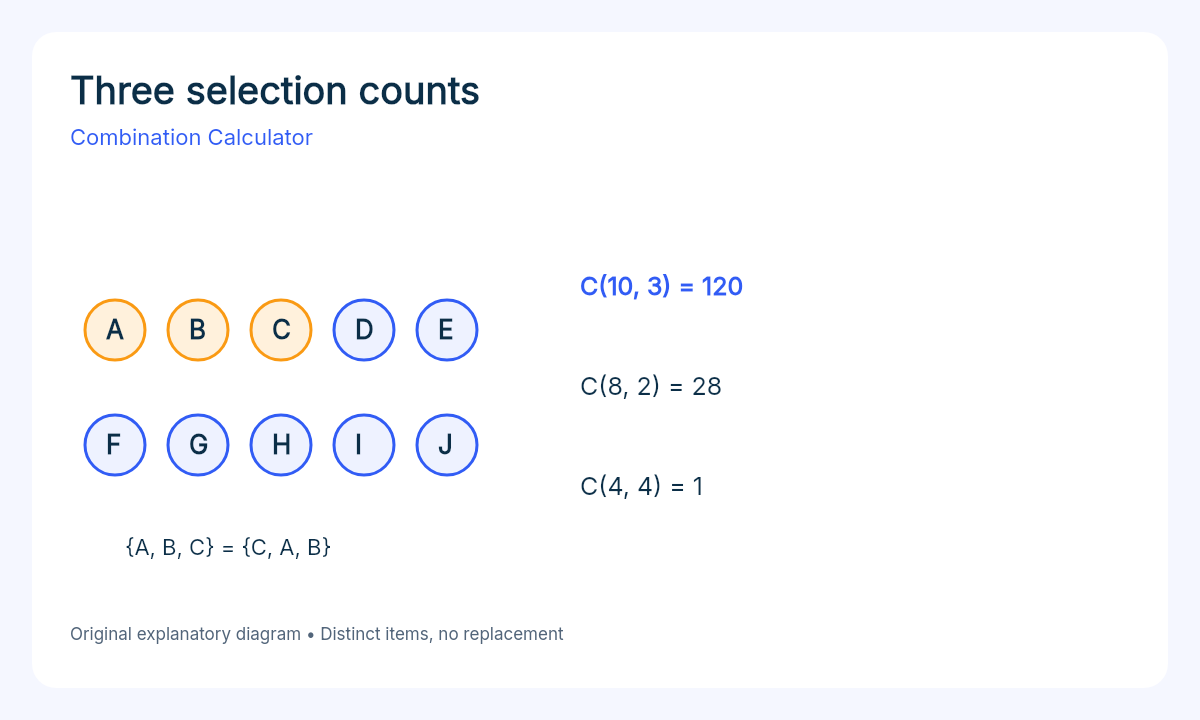
Example one chooses 3 topics from 10 for an unordered shortlist. The result is C(10, 3) = 10! / (3! × 7!) = 120 groups. The same three topics are counted once regardless of the order in which their names are written. Assigning those topics to numbered slots would be a different question.
Example two chooses 2 distinct items from 8. There are 8 × 7 = 56 ordered pairs, but each unordered pair occurs in two orders. Dividing by 2 gives C(8, 2) = 28 groups. A pair containing A and B is the same selection as one containing B and A.
Example three chooses all 4 available items. C(4, 4) = 1 because only one complete group can be selected. The items could still be arranged in 24 orders, but those orders do not create different combinations. The combination result describes membership rather than the positions of the selected items.
Combination calculator symmetry and boundary checks
The combination calculator obeys C(n, r) = C(n, n - r). Choosing r members determines exactly which n - r members were left out, giving a one-to-one match between the two counts. For example, choosing 3 from 10 and choosing 7 from 10 both give 120 possible groups.
Another check is C(n, 1) = n: a one-member group can contain any one available item. Both C(n, 0) and C(n, n) equal 1. The first counts one empty group, while the second counts the complete group. These conventions include C(0, 0) = 1 and keep the formula consistent at its supported boundaries.
Combination calculator check with a small set
For a manual check of the combination calculator, take three distinct items A, B and C and choose two without order. The three groups are {A, B}, {A, C} and {B, C}. Writing {B, A} does not create another group because membership has not changed. The formula gives C(3, 2) = 3, matching the list. A small enumeration can reveal whether an apparent extra outcome is only a different ordering of an existing selection.
Exact counts, input limits and exporting
The combination calculator accepts whole numbers from 0 through 170 for n and r, subject to r not exceeding n. It rejects blank, negative, non-whole and out-of-range entries. Within the supported range, the engine uses exact whole-integer arithmetic. It does not store a large combination count as an approximate floating-point number or add fractional decimal places to an integer result.
Number display changes grouping without changing the count. Copy uses the displayed result when clipboard access is allowed, while CSV saves the represented count as decimal digits. A spreadsheet application may round a long value when treating it as an ordinary numeric cell. Import the exact-count column as text when preservation of every digit is required.
Changing either input hides the previous result until you calculate again. Reset restores the example values. The arithmetic runs in your browser without sending n or r to a calculation service. Keep the inputs and selection assumptions with the answer. Exact arithmetic cannot establish whether the real items are distinct, whether replacement is permitted or whether additional constraints were omitted.
Questions about combination calculator
Can the combination calculator select an item more than once?
No. It uses a without-replacement model, so each distinct item is either present or absent from the selected group. Counting unordered selections with repetition requires a different formula. Do not reinterpret an r value larger than n as automatically permitting repeated selections; this version rejects that input instead.
Does the combination calculator care about the order of names?
No. The same selected members form one combination regardless of how their names are ordered. For example, the group A, B, C is the same as C, A, B. If positions or roles make those arrangements meaningfully different, use an ordered counting model rather than this unordered selection count.
Why does the combination calculator give the same result for r and n minus r?
Choosing the included members also identifies the excluded members. Every group of r selected items corresponds to one group of n - r excluded items, and vice versa. This explains the symmetry C(n, r) = C(n, n - r). It is a useful numerical check and does not mean the selected groups themselves are identical.
Why is choosing zero items counted as one group?
There is exactly one empty group, so C(n, 0) = 1. The result is a mathematical counting convention, not a claim that an item was selected. It also agrees with the factorial formula because 0! = 1. The case n = 0 and r = 0 follows the same convention.
Can this enforce a required item or another restriction?
Not from n and r alone. A requirement such as including one specific member changes the counting problem and must be represented explicitly in a separate method. Some restrictions can be handled by reducing the remaining available items and group size, but that depends on the precise problem. The unrestricted total does not apply every possible condition automatically.
Does a combination count give a probability?
Not by itself. A probability also needs a defined event, an outcome space and an appropriate model of how outcomes are selected. If every group is equally likely, a count may form part of that calculation, but equal likelihood is an additional assumption. This tool reports counts and does not establish the fairness of a selection process.
Can a group size contain a decimal or percentage?
No. r represents a whole number of selected items. A percentage is not a group size until the problem defines how it corresponds to an actual whole-number count. Values such as 2.5 do not describe a valid selection of distinct indivisible items in this model and are therefore rejected.
Are results exact for the largest supported inputs?
The engine performs exact whole-integer arithmetic within the stated limit of n and r up to 170. A long displayed number is retained as an integer rather than rounded to a floating-point approximation. The model still assumes distinct items and no replacement, so arithmetic exactness does not verify whether those assumptions fit the real question.
Why can choosing every item give a smaller result than choosing some items?
Choosing every available item has only one possible group. Choosing an intermediate number can create many different groups because membership can vary. For example, C(4, 4) = 1 while C(4, 2) = 6. The count describes the number of possible selections, not the number of members inside one selected group.
Does the CSV record all previous attempts?
No. It exports the current result rather than a history of inputs. Keep n, r and the assumption of unordered selection without replacement separately if another person needs to reproduce the count. When importing very long integer values into spreadsheet software, check the column type so digits are not silently rounded.
What should I do if copying is unavailable?
Select the displayed count and copy it manually, or use the CSV download when supported. Clipboard and download permissions depend on the browser. A failure of either convenience feature does not change the counting arithmetic. Keep grouping separators and exact digits in mind when moving a long result into another application.
Sources and method notes
Method and source notes checked on 26 November 2026. The diagrams are original explanatory drawings. Read the privacy policy for other site services.