Complex Number Calculator
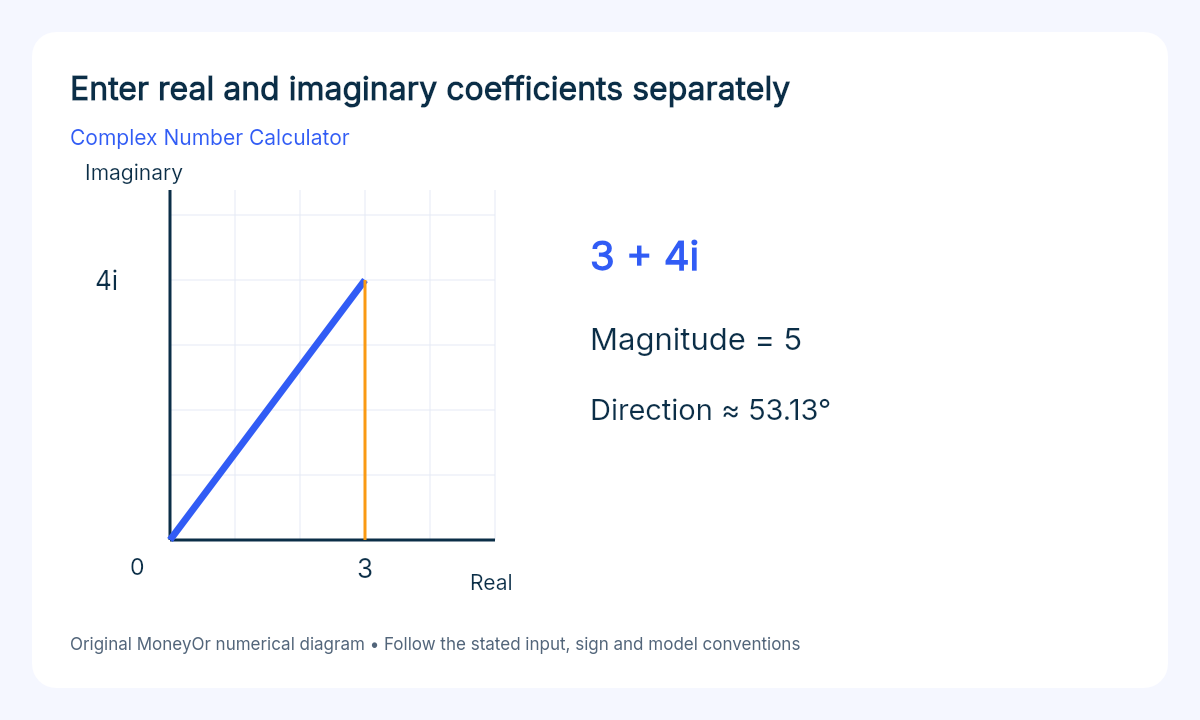
This complex number calculator performs one operation on two numbers in rectangular form, a + bi and c + di. Enter their real parts and imaginary coefficients separately. For (3 + 4i) + (1 + 2i), the answer has real part four and imaginary coefficient six, so it represents 4 + 6i.
Loading calculator. JavaScript is required.
Your result
The complex number calculator also returns the magnitude and principal argument of the resulting number. The imaginary unit satisfies i² = -1. The coefficient beside i is an ordinary real input, which may be positive, negative or zero. This is numerical complex arithmetic, not a symbolic expression parser or an equation solver.
On this page
- How to use the complex number calculator
- Four operations on rectangular components
- Three worked examples with 3 + 4i and 1 + 2i
- Read magnitude and principal argument
- Input scope and numerical limitations
- Choose a suitable interpretation for the result
- Questions about complex number calculator
- Sources and method notes
How to use the complex number calculator
Enter a and b for the first number, then c and d for the second. Select Add, Subtract, Multiply or Divide. For 3 - 4i, enter real part three and imaginary coefficient negative four. A purely real number has imaginary coefficient zero; a purely imaginary number has real part zero.
The complex number calculator requires all four component fields. Enter zero explicitly rather than leaving a field blank. Subtraction means the first number minus the second, and division means the first divided by the second. Swapping the two entries generally changes these answers. Addition and multiplication can be swapped without changing the mathematical result, apart from possible tiny floating-point differences.
Four operations on rectangular components
Addition and subtraction combine matching parts: add or subtract the real components, then do the same with the imaginary coefficients. Multiplication expands (a + bi)(c + di). Because i² = -1, its real part is ac - bd, and its imaginary coefficient is ad + bc. The minus sign in ac - bd comes from the imaginary unit squared.
For division, multiplying numerator and denominator by c - di gives a real denominator c² + d². The complex number calculator evaluates an equivalent scaled division formula to reduce avoidable intermediate range problems. The second complex number must be nonzero. It is invalid only when both c and d are zero, not when either individual component alone is zero.
Three worked examples with 3 + 4i and 1 + 2i
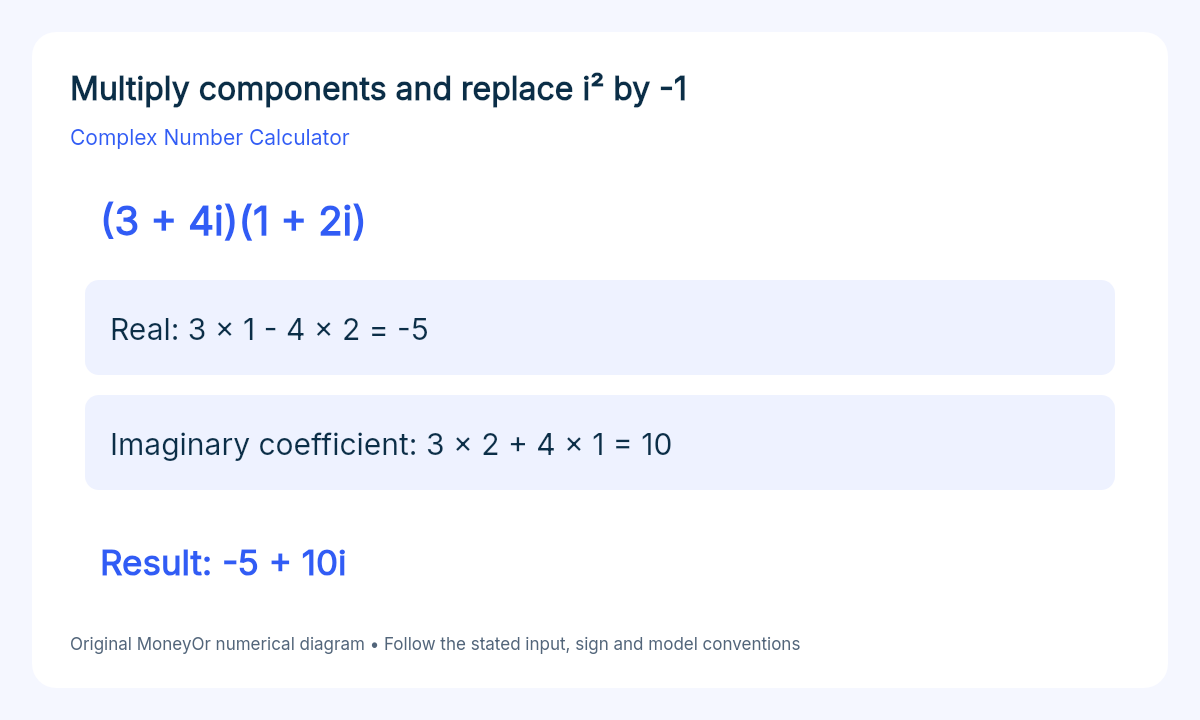
Addition gives (3 + 1) + (4 + 2)i = 4 + 6i. Multiplication gives real part 3 × 1 - 4 × 2 = -5 and imaginary coefficient 3 × 2 + 4 × 1 = 10, so the product is -5 + 10i. These operations use the same components but combine them differently.
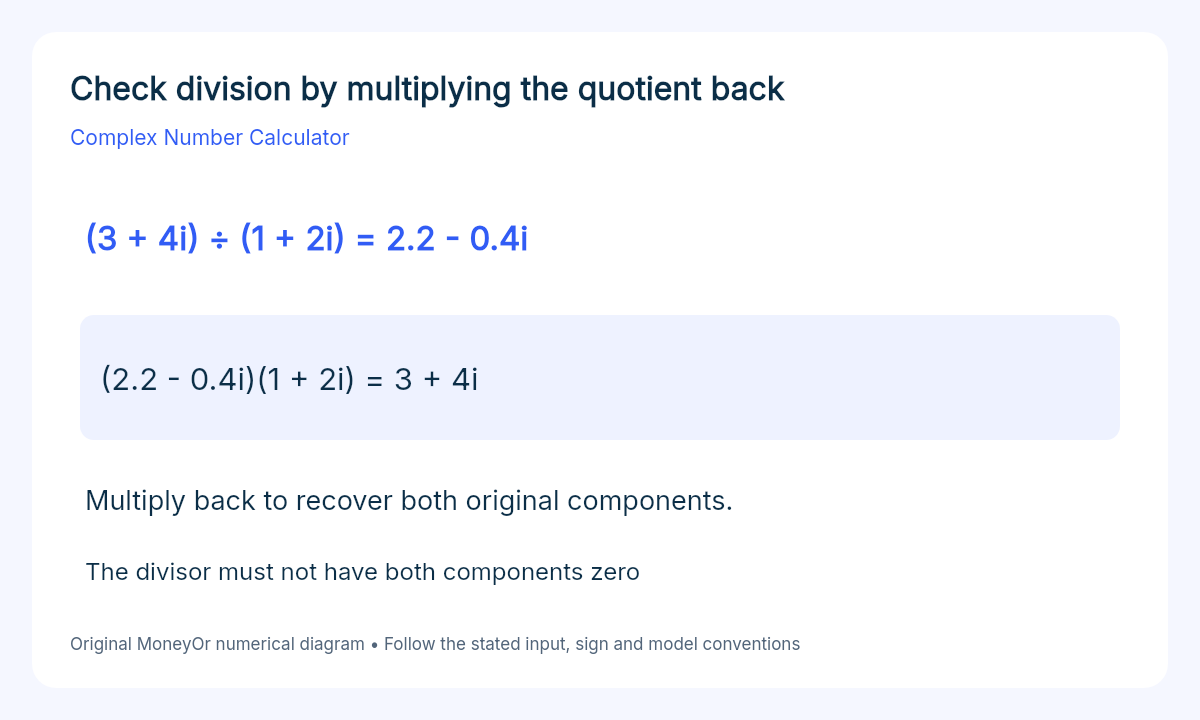
Division gives real part (3 × 1 + 4 × 2)/5 = 11/5 and imaginary coefficient (4 × 1 - 3 × 2)/5 = -2/5. The result is 2.2 - 0.4i. Check it by multiplying that quotient by 1 + 2i: the real part returns three and the imaginary coefficient returns four, within ordinary numerical precision.
Read magnitude and principal argument
For a resulting number x + yi, magnitude is the nonnegative distance from the origin, sqrt(x² + y²). The complex number calculator uses a hypotenuse calculation for this value. A nonzero result also has a direction, reported as its principal argument in degrees. The direction depends on both component signs, not merely on the ratio y/x.
The principal argument lies between negative one hundred eighty and positive one hundred eighty degrees, with equivalent boundary directions depending on signed-zero conventions. The complex number calculator normalizes negative zero components to zero. For the zero complex number, magnitude is zero but argument is undefined, so no numerical angle is assigned. A zero result should not be read as pointing along the positive real axis.
Input scope and numerical limitations
Each component may be zero or have absolute magnitude from 0.000000000001 to 1,000,000,000. Values outside that scope, blank fields and nonfinite entries are rejected. Use decimal values without grouping commas, unit labels or a literal i. The component range is an implementation boundary, not a boundary of the mathematical complex-number system.
The complex number calculator uses ordinary floating-point arithmetic, so decimal components and derived magnitudes or angles may be approximate. Very close cancellations can lose relative precision even when the absolute discrepancy is small. An answer displayed as zero at limited decimal places may have a small nonzero internal component. Retain enough digits when checking the result, and use an appropriate tolerance rather than exact text equality for approximate values.
Choose a suitable interpretation for the result
This complex number calculator does not attach physical units or a frequency to the components. If they represent electrical quantities, confirm that their units, reference direction, frequency and phase convention are compatible before operating on them. The mathematical result alone cannot decide whether adding or multiplying two physical quantities is meaningful.
To check a product, expand it manually and replace i² with negative one. To check a quotient, multiply it by the nonzero divisor and compare both components with the original dividend. For magnitude, a 3 + 4i result gives five, forming the familiar three-four-five right triangle. A principal angle describes direction modulo a full turn, so adding three hundred sixty degrees gives an equivalent direction.
Questions about complex number calculator
What does a complex number calculator accept?
This form accepts the real part and imaginary coefficient of each of two complex numbers, plus one of four operations. Enter numerical components separately rather than typing a complete expression containing i. Both signed decimals and zero are supported within the stated magnitude range. The output is numerical, so it does not preserve symbolic fractions or radicals.
Why is the imaginary input a real coefficient?
In a + bi, b is a real number multiplying the imaginary unit. To enter 3 - 4i, use a = 3 and b = -4. The form already knows that the second component multiplies i, so putting the letter i into the coefficient field would not be a valid numerical entry.
How does the complex number calculator multiply two values?
It expands the product and uses i² = -1. For a + bi and c + di, the real part becomes ac - bd and the imaginary coefficient becomes ad + bc. With 3 + 4i and 1 + 2i, that produces -5 + 10i. Multiplying real parts and imaginary coefficients separately would miss the cross terms.
Can I divide by a purely imaginary number?
Yes, provided it is nonzero. A divisor with real part zero and imaginary coefficient two represents 2i, which has a valid reciprocal. Division is rejected only when both components of the divisor are zero. A zero real part alone does not make a complex number zero, just as a zero imaginary coefficient alone does not.
What is the magnitude of the result?
Magnitude is its distance from zero in the complex plane. For x + yi, it is sqrt(x² + y²) and is always nonnegative. A 3 + 4i result has magnitude five. The magnitude of a product equals the product of the operand magnitudes mathematically; floating-point outputs may differ by small numerical rounding amounts.
Does the complex number calculator return degrees or radians?
The displayed principal argument is in degrees. The numerical direction is determined from both component signs using a two-argument arctangent, then converted from radians internally. Do not paste that degree value into a system expecting radians without conversion. Equivalent directions differ by whole turns, so principal argument selects one conventional representative of those directions.
Why is the argument of zero undefined?
Zero is located at the origin of the complex plane and has no unique direction from that origin. Every angle would describe the same point when the magnitude is zero. The complex number calculator therefore reports the argument as undefined instead of presenting a numerical angle that could be mistaken for a meaningful phase.
Can this convert a number entered in polar form?
The inputs use rectangular components only. If you know magnitude and angle, convert them to real and imaginary components using a consistent angle unit before entering them. The result includes magnitude and principal argument, but this form does not parse a polar expression, a degree symbol or a complex exponential written as text.
Why might a nearly cancelling result have a tiny residual?
Ordinary floating-point numbers store a finite approximation to many decimal values. Operations on almost equal components can leave a small residual or lose relative precision. The complex number calculator is numerical rather than arbitrary-precision symbolic software. Compare approximate answers with a tolerance suited to the problem and retain more digits before drawing conclusions from apparent cancellation.
Does changing the order of the numbers matter?
It matters for subtraction and division. The form always evaluates first minus second or first divided by second. Addition and multiplication commute mathematically, although different floating-point evaluation paths can create very small numerical discrepancies. Check operand order before copying a quotient, especially when one complex number represents a reference quantity and the other represents a response.
Can the output be used directly as an electrical phase result?
Only after you verify the physical model, compatible units and the phase convention used by your own application. This complex number calculator performs mathematical operations on numerical components. It does not know frequency, circuit topology, uncertainty or whether a phasor uses a particular time-sign convention. Those assumptions must come from the engineering problem, not from the arithmetic output.
Sources and method notes
Method and source notes checked on 26 November 2026. The diagrams are original explanatory drawings. Read the privacy policy for other site services.