Cone Volume Calculator
This cone volume calculator finds volume, slant height, base area, curved surface area and total surface area from radius and perpendicular height. It assumes a complete right circular cone. For radius 3 and height 4 centimetres, the slant height is 5 centimetres, volume is about 37.69911184 cubic centimetres and total surface area is about 75.39822369 square centimetres.
Loading calculator. JavaScript is required.
Your result
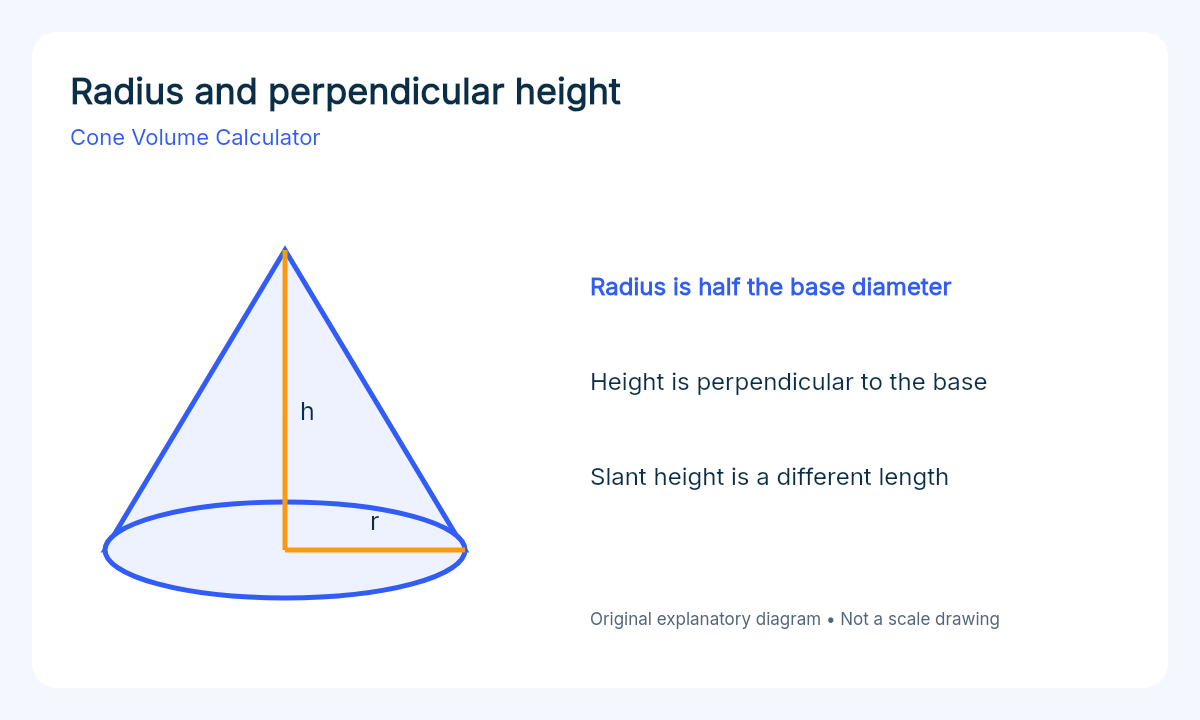
In the cone volume calculator, radius measures from the base centre to its edge. Perpendicular height runs from the base plane to the apex along the cone's central axis. The sloping edge is a different length. This version does not model a truncated cone, a frustum or an oblique cone.
On this page
How to use the cone volume calculator
Measure the radius of the circular base and the perpendicular height to the tip. If you know the full base diameter, divide it by two first. Enter both values using the same unit and a decimal point without grouping commas. Do not put the sloping edge into the height field; the calculator derives that slant height as an output.
The selected unit labels the result without converting the input numbers. A radius and height in metres produce cubic metres for volume and square metres for area. Convert mixed dimensions before calculating. For a container estimate, establish the appropriate internal geometry rather than assuming that outside measurements describe the usable inside space.
Volume and right-cone surface formulas
Volume = π × r² × h / 3. A cone has one third of the volume of a cylinder with the same circular base and perpendicular height. One base area is πr². For a right circular cone, slant height s = square root of r² + h². The implementation uses the browser's hypot function for this right-triangle calculation.
Curved surface area = πrs. Total surface area = πrs + πr², or πr(s + r). Total includes the flat circular base as well as the curved side. For an open cone without a base covering, the curved area is the relevant geometric component. The cone volume calculator reports both components so the included surfaces remain clear.

Three worked examples
Example one uses radius 3 and height 4 centimetres. Slant height is square root of 9 + 16 = 5 centimetres. Volume is 12π, approximately 37.69911184 cubic centimetres. Base area is 9π square centimetres, curved area is 15π square centimetres and total surface area is 24π, approximately 75.39822369 square centimetres.
Example two uses radius 5 and height 12 metres. Slant height is 13 metres. Volume is 100π, approximately 314.15926536 cubic metres. Base area is 25π square metres, curved area is 65π square metres and total surface area is 90π, approximately 282.74333882 square metres. The familiar 5, 12, 13 right triangle helps check the slant calculation.
Example three uses radius 1 and height 1 inch. Slant height is square root of 2, approximately 1.41421356 inches. Volume is π / 3, approximately 1.04719755 cubic inches. Base area is π square inches and curved area is π times square root of 2 square inches. Total surface area is approximately 7.58447559 square inches.

Checks for dimensions and scaling
The slant height must be longer than either positive input individually. Total surface area minus curved surface area must equal the base area. Volume divided by base area must equal height divided by three. These relationships provide independent checks on the reported outputs without repeating each full formula.
A horizontal slice near the tip is smaller than the full base, so a partly filled or shortened cone needs another geometric step. Do not simply multiply total volume by the fraction of height filled: volume varies with the cube of height for similar cones.
Doubling radius and height together multiplies volume by eight and every surface area by four. Doubling only height doubles volume, but it changes slant height and curved area through a square-root relationship. If the volume seems four times too large at the same height, check whether diameter was entered as radius. That error doubles radius, which is squared in the volume formula.
Precision, limits and practical use
Radius and height must each be between 0.000000001 and 1,000,000,000. Zero, negative, blank and non-finite values are rejected. Results usually show up to eight decimal places; very small or very large quantities use scientific notation. The browser uses finite number precision and its built-in π value. Keep extra precision during later steps and round the final answer to suit the measurements.
Changing an input hides the previous result until you calculate again. Reset restores the sample values. Copy uses displayed numbers when clipboard permission is available. CSV downloads the represented numerical results with their unit labels. The calculation runs locally without sending dimensions to an external calculation API.
Volume is expressed in cubic length units, not automatically in litres or gallons. Use a compatible volume conversion if a capacity unit is needed. The geometry does not include wall thickness, seams, material overlaps, a missing tip or a chosen fill level. Those details can change a physical object's capacity or the material required. Treat the result as a complete ideal right cone and handle the actual project requirements separately.
Cone Volume Calculator: Swapping radius and height changes the cone
The cone volume calculator treats radius and perpendicular height as different dimensions. Swapping them leaves the calculated slant height unchanged because the same two squares are added. It does not generally preserve volume or surface area, since radius also determines the circular base. Always keep the labels with the measurements when entering a diagram's numbers.
For a check in the cone volume calculator, compare radius 3 and height 4 with radius 4 and height 3. Both have slant height 5 units. Their volumes are 12π and 16π cubic units respectively, and their total surface areas are 24π and 36π square units. Equal slant heights alone therefore do not determine equal cones.
Questions about cone volume calculator
Is height measured along the sloping edge?
No. Enter perpendicular height along the central axis. Slant height is calculated separately.
Does total surface area include the circular base?
Yes. Total includes one flat circular base and the curved side. The curved area is also reported on its own.
Can this calculate a frustum?
No. A frustum needs two radii and a different volume formula. This version assumes a complete cone with an apex.
Why is the volume divided by three?
A cone has one third of the volume of a cylinder with the same base area and perpendicular height.
Does this calculate an oblique cone?
No. The slant-height and surface-area outputs assume a right circular cone with its apex directly above the base centre.
Can the cone volume calculator use a diameter directly?
No. Divide a measured base diameter by two before entering radius. For a diameter of 6 units and perpendicular height of 4 units, enter radius 3 and height 4. Using 6 as radius instead would make the volume four times as large at the same height, because radius is squared in the volume formula.
Does the cone volume calculator create a material cutting pattern?
No. It reports geometric surface areas, not a printable net, seam allowance or cutting template. A practical cone-shaped covering depends on details such as joining method, usable sheet size and overlap. The curved-area result can help describe the ideal surface, but it does not establish how many pieces or sheets a project needs.
Can the cone volume calculator determine the mass of a solid cone?
Volume alone does not determine mass. A uniform solid also requires an appropriate material density in compatible units. A hollow cone needs additional inner dimensions before its material volume can be established. This tool does not ask for density, wall thickness or material type and therefore does not report mass or weight.
Does half the height mean half the volume?
Not for a smaller similar cone cut from the tip. Halving all of that smaller cone's linear dimensions produces one eighth of the full cone's volume. A partly filled vessel needs its orientation and fill geometry to be defined. This version assumes a complete ideal cone and does not calculate a fill-depth volume.
Are volume and surface area in the same unit?
They have different dimensions. Radius and height in metres produce volume in cubic metres and surface areas in square metres; slant height remains in metres. Keep those labels with copied values. Changing the unit selector does not convert the input numbers or turn a volume result into an area result.
What does the CSV save for a cone calculation?
The export contains volume, slant height, base area, curved surface area and total surface area with numerical values and units. It is not a record of earlier attempts. Keep radius, perpendicular height and measurement notes separately when another person needs to reproduce the calculation or check whether the right-cone assumption applies.
Sources and method notes
Method and source notes checked on 26 November 2026. The diagrams are original explanatory drawings. Read the privacy policy for other site services.