Currency Converter
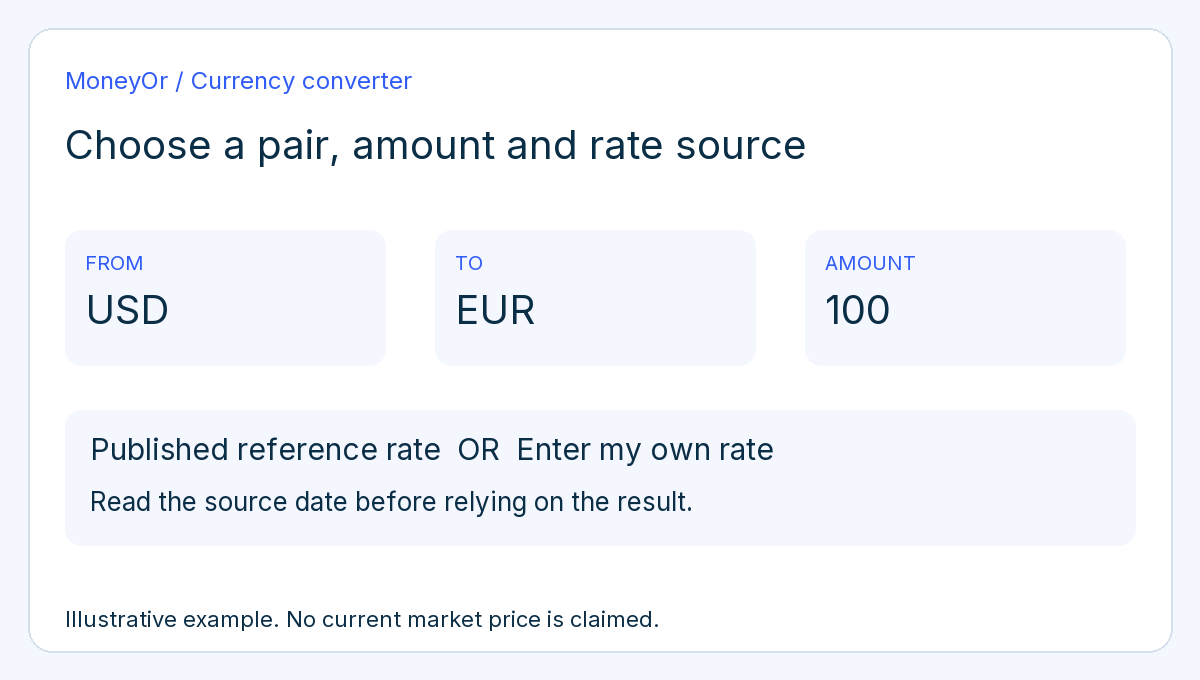
Use this currency converter to multiply an amount by a published reference rate or a rate you enter yourself. Choose the source and target currencies, enter the amount, then select Convert amount. The result identifies the currency codes and explains which rate was used.
Loading converter. If this message stays visible, reload with JavaScript enabled.
Exchange-rate source: Frankfurter. When you choose a published rate, MoneyOr requests the currency pair through its server. Your amount stays in this page. Manual conversions do not contact the rate API.
A converted estimate is useful for comparing prices, planning a budget or checking arithmetic. It does not tell you the amount a bank, card provider or transfer service will deliver. Those providers can use a different exchange rate and add fees. Compare their final quoted amounts before paying.
On this page
How to use the currency converter
Start with the currency you already have in the From field. Choose the currency you want to receive in the To field. Enter a nonnegative amount using a decimal point. For example, an amount of 100 means one hundred units of the selected source currency, rather than one hundred units of the target currency.
Published reference rate asks MoneyOr to retrieve a dated rate through its server. Your amount is multiplied in this page and is not included in the provider request. Choose Enter my own rate if you have a bank quote or want to explore a scenario. Enter the number of target units that one source unit buys.
Number display changes separators and grouping in the result. It does not change the currency pair, fetch a different price or convert a typed comma into a decimal point. Use the currency codes alongside the numbers to avoid confusing currencies that share a dollar symbol.
Formula and worked example
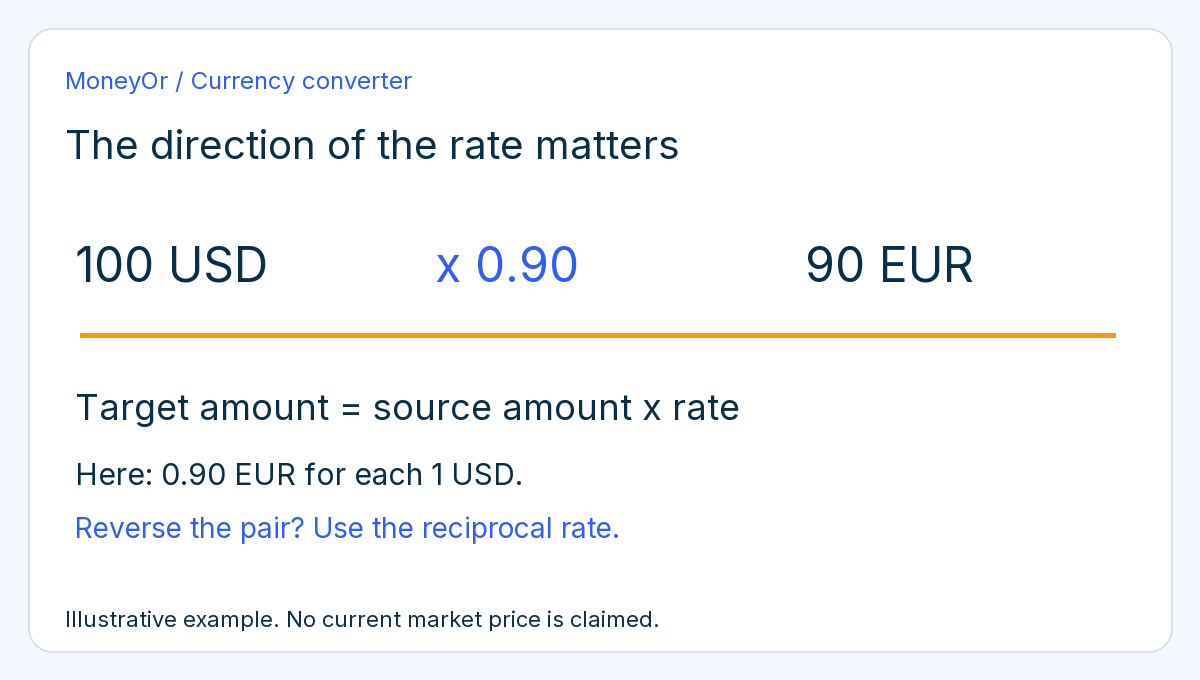
This currency converter uses the formula target amount = source amount × exchange rate. The direction matters: the rate must state how many units of the target currency one unit of the source currency buys. If you reverse the pair, use the reciprocal rate instead of repeating the original rate.
Suppose you enter an illustrative rate of 0.90 EUR for one USD. Converting 100 USD gives 90 EUR because 100 × 0.90 = 90. Reversing the same illustrative relationship uses approximately 1.111111 USD per EUR. These example numbers explain the method and are not a claim about today's exchange rate.
The calculator keeps the multiplication result before formatting it for display. Currency formatting rounds the displayed result according to that currency's usual minor units. A bank can apply its own rounding rules. Avoid repeatedly converting already rounded display values when reconciling a longer chain of transactions.
Currency converter rate dates
The reference-rate option uses Frankfurter's public currency API. Frankfurter aggregates published reference data from official sources. The date shown belongs to the returned rate. It can differ from the day you open this page, including around weekends, holidays and a provider's publication schedule.
MoneyOr caches a retrieved pair for up to six hours to reduce repeat requests. The result states when a cached reference is used. The integration rejects missing, future, invalid or more than seven-day-old rate dates. A successful response is still a reference estimate, not a real-time market quote or a promise that you can trade at that rate.
If the provider is unavailable or a recent rate cannot be validated, the tool asks you to try again or enter a rate manually. It does not silently substitute a sample price. When both selected currencies are the same, the multiplier is one and an external quote is unnecessary.
Bank spreads, transfer fees and practical limits
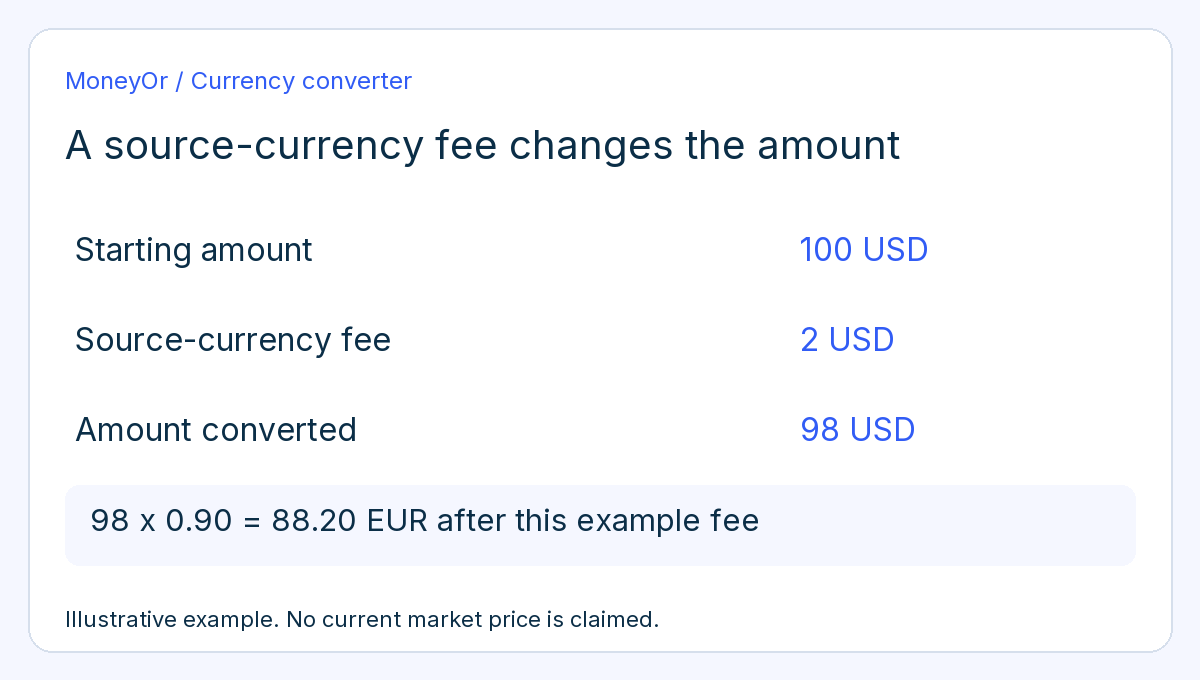
A provider's spread is the difference between a comparison rate and the rate it offers you. An additional transfer fee may be charged in the source currency, the target currency or separately. The order matters: subtracting a source-currency fee before conversion can produce a different answer from subtracting the same number in the target currency afterward.
For an illustrative comparison, 100 USD at 0.90 EUR per USD gives 90 EUR before fees. If a service takes a 2 USD fee from that amount first, 98 × 0.90 gives 88.20 EUR. This is a hypothetical arithmetic example. Use the service's actual quote, fee currency and payment conditions to compare a real transfer.
If the service instead subtracts a 2 EUR fee after conversion, the estimate is 90 - 2 = 88 EUR. This differs from 88.20 EUR because the fee is in another currency. In this currency converter, work out fees separately using the provider's stated order and currency.
This tool covers the supported currencies listed in its selectors. It does not calculate cryptocurrency prices, historical tax reporting rates, merchant card settlement, foreign-exchange gains or country-specific tax obligations. For a filing or accounting requirement, check the specific official rate and convention that the relevant authority requires.
Currency converter privacy checks
Manual mode performs its calculation in the browser. Published-rate mode sends only the selected currency codes from MoneyOr's server to Frankfurter. The calculator does not ask for account details or store your amount in a MoneyOr calculation history. Other site services, hosting logs and consent choices are covered separately in the privacy policy.
Before using an estimate, check the From and To codes, read the rate date and confirm whether the rate was entered manually. Compare the result with a simple multiplication. If you change the amount, currency pair or rate source, the old result is hidden so that it cannot be mistaken for the new scenario.
Currency converter questions
Does this currency converter show a live trading rate?
No. Published mode uses a dated reference rate. Manual mode uses the rate you enter. Neither is a guaranteed bank or trading quote.
Can I use my bank's exchange rate?
Yes. Select Enter my own rate and enter target units per source unit. Check fees separately because the calculator does not infer them from a bank quote.
Why is the rate date earlier than today?
Reference data follows its publishers' schedules and can be affected by weekends or holidays. Read the returned date. MoneyOr rejects a rate date more than seven days old.
Sources and method notes
Method and source notes checked on 25 November 2026. The examples use illustrative rates. Read the privacy policy for other site services.