Cylinder Volume Calculator
This cylinder volume calculator finds volume, total surface area, curved surface area and the area of one circular base. Enter radius and perpendicular height in the same unit. A cylinder with a radius of 3 centimetres and height of 5 centimetres has a volume of about 141.37166941 cubic centimetres and a total surface area of about 150.79644737 square centimetres.
Loading calculator. JavaScript is required.
Your result
The cylinder volume calculator models a right circular cylinder with two flat circular ends. It does not represent a tapered vessel, an angled cut or a partly filled horizontal tank. For an internal capacity estimate, use appropriate inside dimensions rather than the outside dimensions of a thick-walled object.
On this page
- How to use the cylinder volume calculator
- What each cylinder formula measures
- Three worked examples
- Checks that catch common input mistakes
- Precision, capacity and saving your calculation
- Cylinder Volume Calculator: Use the surface components for the intended model
- Questions about cylinder volume calculator
- Sources and method notes
How to use the cylinder volume calculator
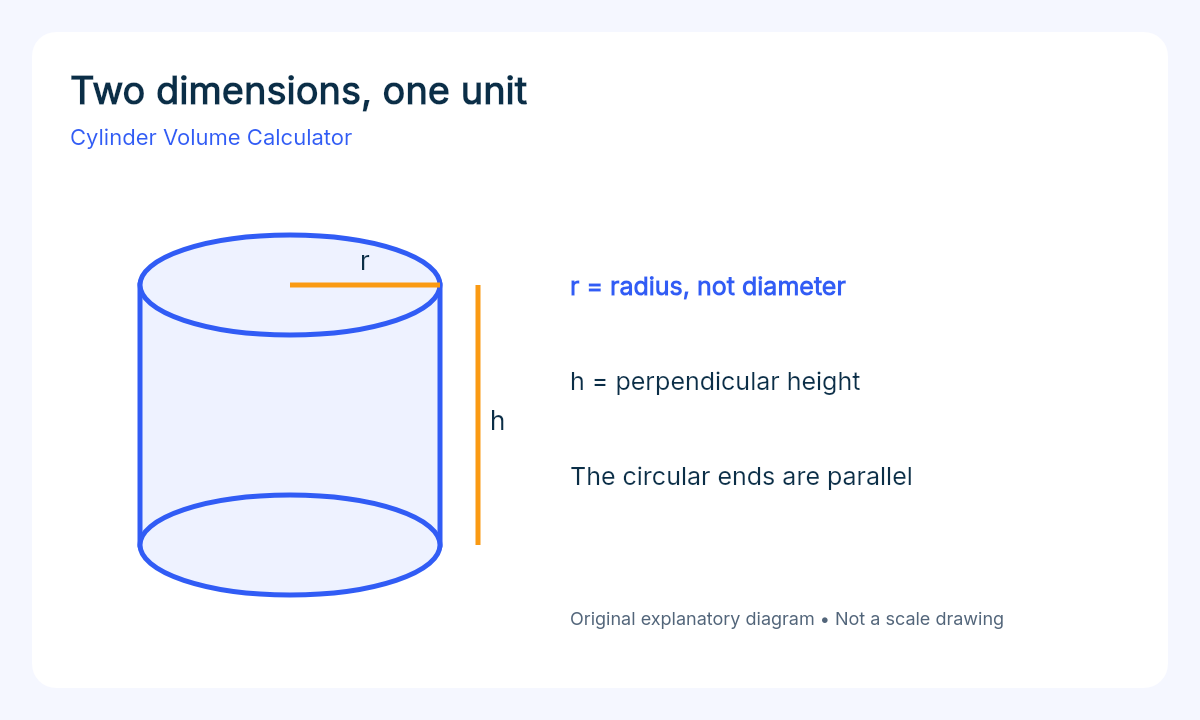
Radius runs from the centre of a circular end to its edge. If you measured the whole width across the end, divide that diameter by two. Height is the straight perpendicular distance between the two parallel ends. For this right cylinder, that is also the length along a straight line on its side parallel to the central axis.
Both measurements must use one unit. Convert a radius in centimetres and a height in metres before entering them together. Changing the unit selector only changes labels. It never rescales the numbers. Use decimal points without grouping separators. You can change the number display separately to read results with your preferred grouping and decimal style.
What each cylinder formula measures
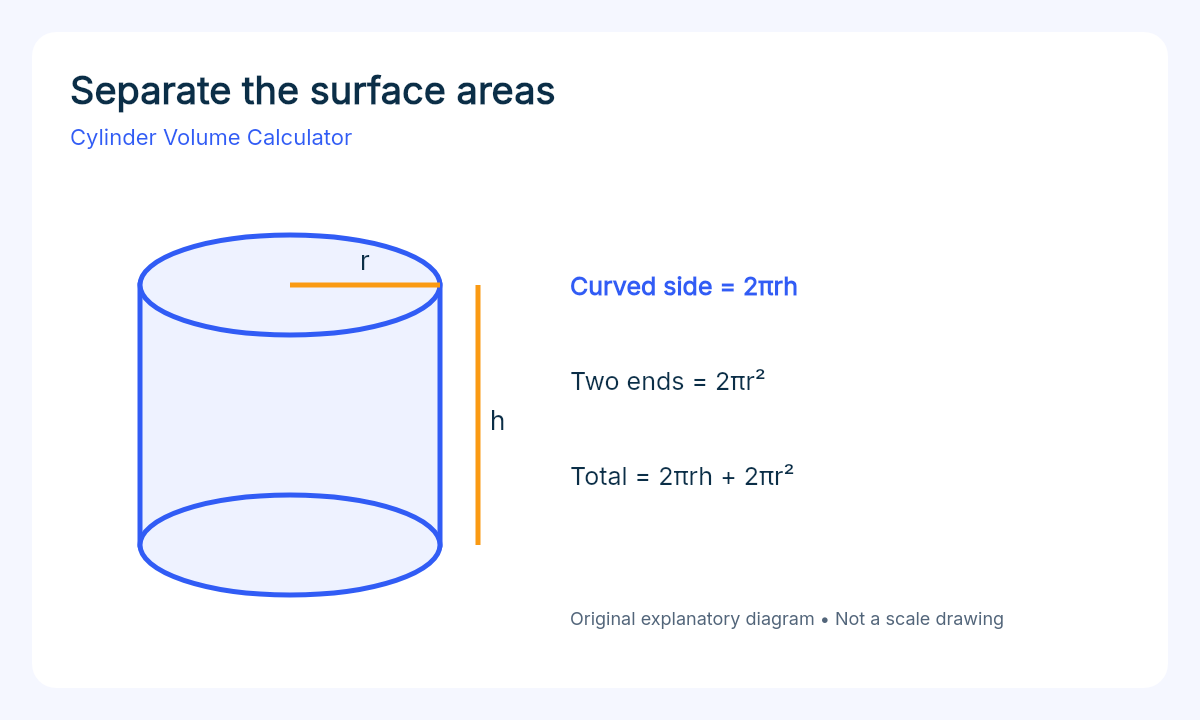
The area of one circular base is π × r². Volume = π × r² × h, so it is base area multiplied by height. Curved surface area = 2 × π × r × h. Imagine unrolling the curved side into a rectangle: its width is the base circumference, 2πr, and its other dimension is height.
Total surface area = 2πr² + 2πrh, or 2πr(r + h). It includes the curved side and both circular ends. An open container with only one end has a different surface area. The cylinder volume calculator reports curved area and one-base area separately, so you can identify the components rather than silently treating every cylinder as an open container.
Three worked examples
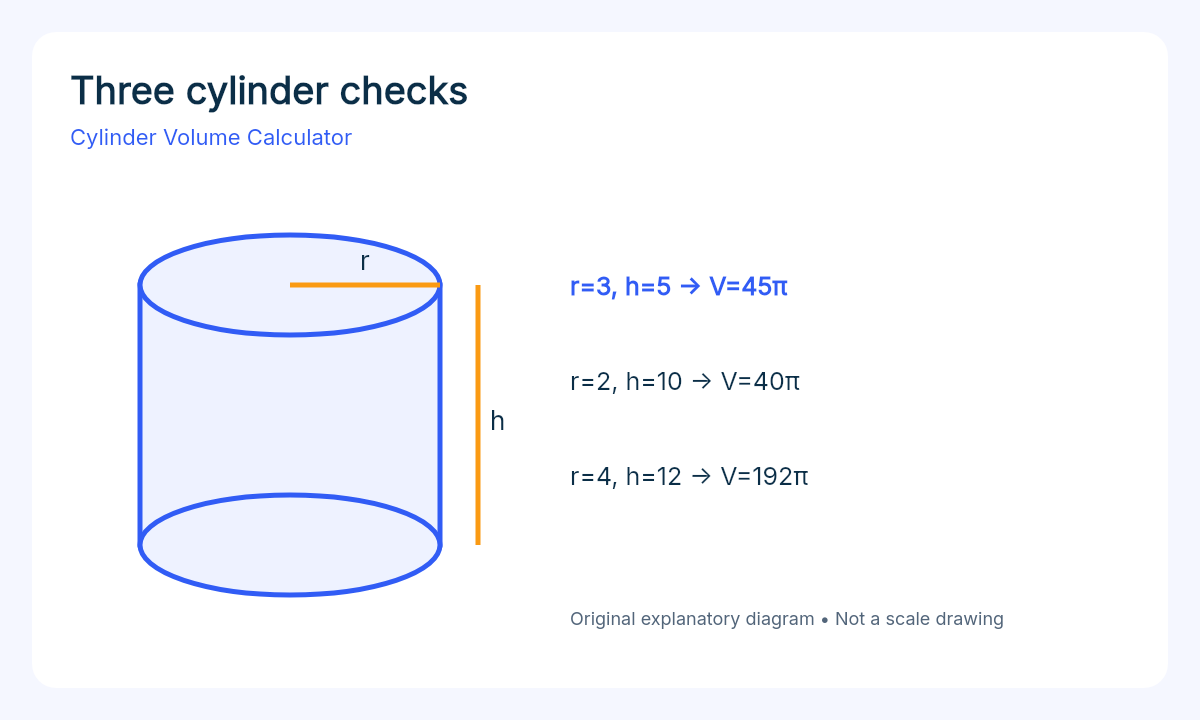
Example one uses radius 3 and height 5 centimetres. One base is 9π square centimetres. Volume is 45π, approximately 141.37166941 cubic centimetres. Curved area is 30π, approximately 94.24777961 square centimetres. Total surface area is 48π, approximately 150.79644737 square centimetres. The two bases contribute the remaining 18π square centimetres.
Example two uses radius 2 and height 10 metres. Volume is 40π, approximately 125.66370614 cubic metres. One base is 4π square metres, curved area is 40π square metres and total surface area is 48π square metres. Although its total surface area matches example one's numerical value, the length units and enclosed volumes are different.
Example three starts with a diameter of 8 inches and height of 12 inches. Divide diameter by two to enter radius 4. Volume is 192π, approximately 603.18578949 cubic inches. Curved area is 96π square inches, one base is 16π square inches and total surface area is 128π, approximately 402.12385966 square inches.
Checks that catch common input mistakes
With radius fixed, doubling height doubles volume and curved area. It does not double total surface area because the circular ends stay the same size. With height fixed, doubling radius multiplies volume and each base area by four, while curved area doubles. These relationships help distinguish a wrong radius from a wrong height or an incorrect surface-area interpretation.
For another check, total surface area minus curved area must equal twice the reported base area. Volume divided by base area must equal height. If an answer seems unexpectedly large, check whether you entered diameter in the radius field. That error multiplies volume by four when height stays the same. It also changes the two surface-area components by different factors.
Precision, capacity and saving your calculation
Radius and height must each fall between 0.000000001 and 1,000,000,000. The calculator rejects blank, zero, negative and unsupported values. Results ordinarily use up to eight decimal places; very small or large numbers switch to scientific notation. The formulas use the browser's π constant and finite number precision. Displayed decimal places do not guarantee the same accuracy in your measurements.
Volume is reported in cubic length units, not automatically in litres or gallons. If you need a capacity unit, use a compatible volume converter and check which gallon definition applies. Capacity calculations also need the correct internal geometry, usable fill level and any space occupied by fittings. This tool assumes the whole ideal cylinder is included.
Copy saves the displayed results when clipboard access is allowed. CSV downloads the represented numerical values and unit labels. Editing a field hides the old answer until you calculate again, and Reset restores the sample dimensions. The arithmetic runs locally and does not send dimensions to an external calculation API. For a container with an open top, combine the curved area and one base area explicitly rather than using the closed-cylinder total. Use the geometric output as a starting measurement, with separate allowances for seams, lids, cutting waste, wall thickness or engineering requirements when they matter to your project.
Cylinder Volume Calculator: Use the surface components for the intended model
The cylinder volume calculator reports the curved side and one circular base separately from total surface area. Its total is for a closed cylinder with two ends. To describe an ideal open-top surface, combine the curved area with one base area. This changes the included surfaces without changing the formula for enclosed cylindrical volume.
When using the cylinder volume calculator for a physical vessel, record whether radius and height were measured inside or outside. Mixing an outside radius with an internal height combines two different geometric descriptions. The single-cylinder model also leaves out wall thickness, fittings and usable fill level. Those details require additional measurements rather than an automatic correction hidden in the result.
Questions about cylinder volume calculator
Is the total surface area for an open cylinder?
No. Total surface area includes two flat circular ends. Curved area and one-base area are reported separately.
Should I enter radius or diameter?
Enter radius. Divide a measured diameter by two first. Using diameter as radius makes volume four times as large at the same height.
Does the result use litres?
No. Volume is in the cubic form of your selected length unit. Use a compatible conversion for litres or other capacity units.
Can this calculate a partly filled horizontal tank?
No. It assumes the entire ideal cylinder. A partly filled horizontal cylinder needs a circular-segment calculation and a fill depth.
Does changing height affect the base area?
No. Base area depends only on radius. Height affects volume and curved surface area.
Can the cylinder volume calculator find an open-top surface area?
Its total surface area includes two circular ends. For an ideal open-top cylinder with one base, add the separately reported curved area and one-base area. With radius 3 and height 5, that is 30π + 9π = 39π square units. Keep material overlap, rims and thickness as separate project-specific considerations.
Does the cylinder volume calculator use internal or external dimensions?
It uses whichever dimensions you enter and cannot infer their physical location. Internal dimensions are normally the relevant starting point for an ideal interior volume, while outside dimensions describe a larger outside cylinder when walls have thickness. Choose one consistent geometric description and record that choice with the result before applying a capacity interpretation.
Why does the cylinder volume calculator need perpendicular height?
The volume formula multiplies circular base area by the perpendicular distance between the parallel ends. For a right cylinder, this is also the axial length. A diagonal distance across the object is not the same measurement. If an end is angled or the vessel is tapered, this simple right circular cylinder model no longer describes all its geometry.
Can changing height alter the total surface area by less than twice as much?
Yes. Doubling height doubles the curved side but leaves both base areas unchanged when radius stays fixed. Total surface area therefore increases by a smaller factor than two. With radius 3 and heights 5 and 10, total areas are 48π and 78π square units respectively, while volumes are 45π and 90π cubic units.
Can I convert the result to gallons?
Yes, after choosing a compatible volume conversion and specifying which gallon definition is intended. US liquid gallons and imperial gallons represent different volumes. The output here remains in cubic length units, so it does not silently select a gallon system. Retain the original dimensions and units when moving the result to a converter.
Does rotating a full ideal cylinder change its volume?
No. A complete ideal cylinder has the same geometric volume regardless of its orientation. Orientation matters for a partly filled vessel because the liquid boundary cuts its shape differently. This tool assumes the whole cylinder is included and does not use fill depth, so it cannot determine a horizontal tank's partial contents from height alone.
Sources and method notes
Method and source notes checked on 26 November 2026. The diagrams are original explanatory drawings. Read the privacy policy for other site services.