Exponential Decay Calculator
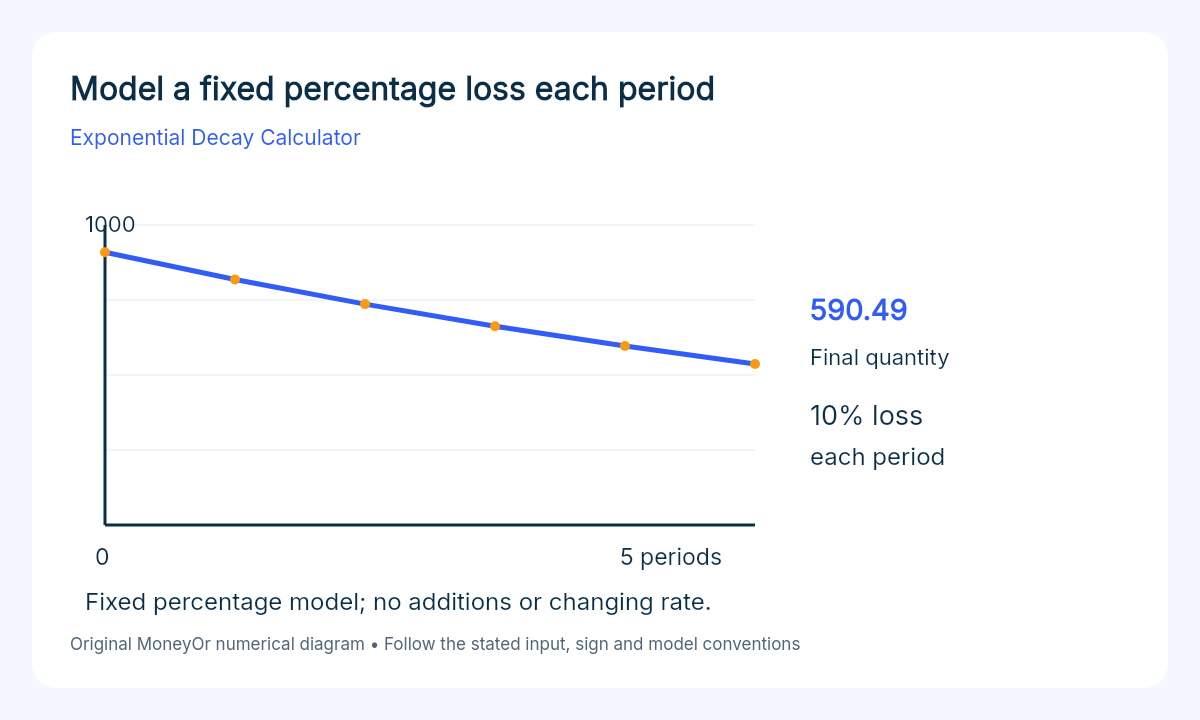
This exponential decay calculator estimates the quantity left after a fixed percentage loss each period. Starting with 1000 and losing ten percent per period for five periods leaves approximately 590.49. Each loss is calculated from the quantity remaining, so the numerical amount lost becomes smaller as the quantity decreases.
Loading calculator. JavaScript is required.
Your result
The exponential decay calculator reports the final remaining quantity, its signed change from the start and its total percentage change. Enter a positive loss percentage, such as ten for a ten percent reduction. The form uses a repeated percentage multiplier. It does not infer a half-life, fit measured observations or predict that a real process must follow the model.
On this page
- How to use the exponential decay calculator
- Calculate the remaining fraction each period
- Three decay examples with explicit remaining quantities
- Distinguish per-period loss from a continuous decay constant
- Zero duration, complete loss and numerical boundaries
- Check whether repeated proportional loss is appropriate
- Questions about exponential decay calculator
- Sources and method notes
How to use the exponential decay calculator
Enter the initial nonnegative quantity, the loss percentage per period and the number of periods. Calculate to see what remains. Use matching periods: a monthly loss rate requires a count of months, while an annual loss rate requires a count of years. Units for the initial quantity carry through to the final quantity.
The exponential decay calculator accepts period counts with fractional parts. This evaluates a smooth power-function extension between complete periods. It does not specify how a contract, inventory policy or observed process handles a partial period. Confirm that interpolation is suitable before treating an answer for half a period as a physical or contractual amount.
Calculate the remaining fraction each period
For initial quantity A, loss percentage d and period count n, the final quantity is A × (1 - d/100)^n. A ten percent loss gives a remaining factor of 0.9. One period leaves ninety percent, and two periods leave 0.9 × 0.9 = 0.81 of the start. The percentages multiply through the remaining quantity.
The exponential decay calculator evaluates the power using numerical logarithm and exponential functions, with functions suited to retaining precision for small percentage changes. Absolute change is final minus initial and is normally negative for decay. Total percentage change is that signed difference divided by a nonzero initial quantity, multiplied by one hundred. A negative change indicates loss; its positive magnitude is the amount lost.
Three decay examples with explicit remaining quantities
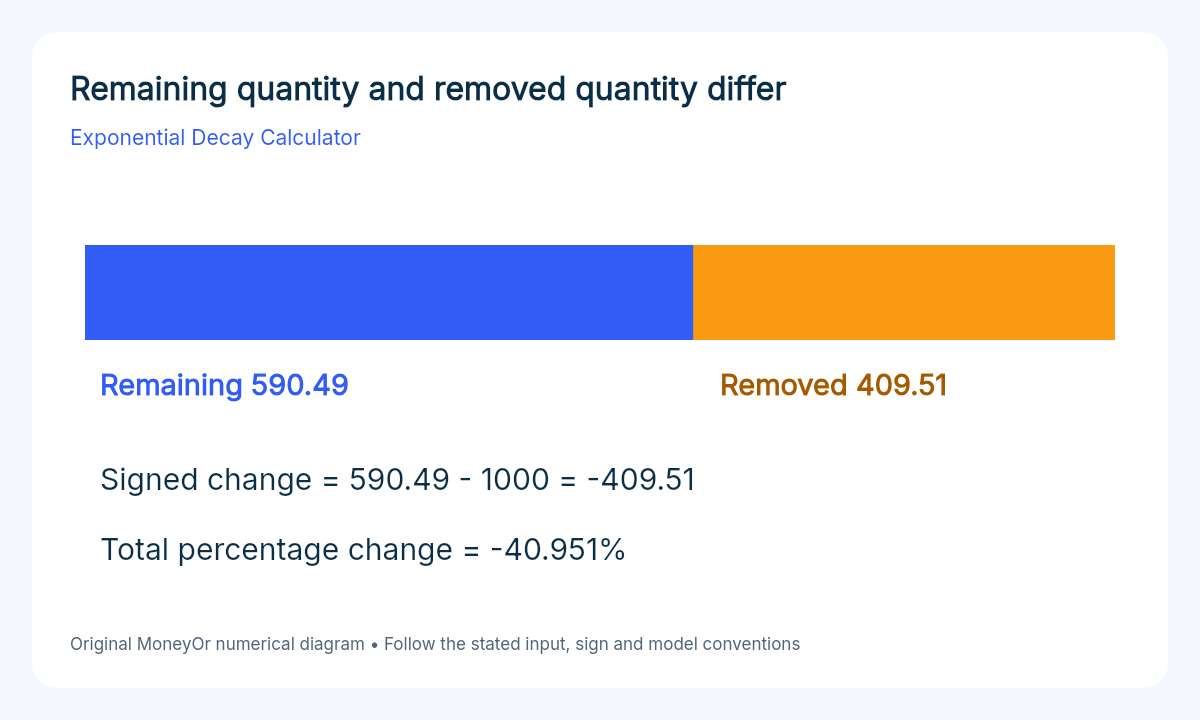
First, 1000 at ten percent loss over five periods gives 1000 × 0.9^5 = 590.49. The absolute change is -409.51, and the total percentage change is -40.951 percent. The total loss is smaller than fifty percent because each successive ten percent reduction acts on a smaller remaining quantity.
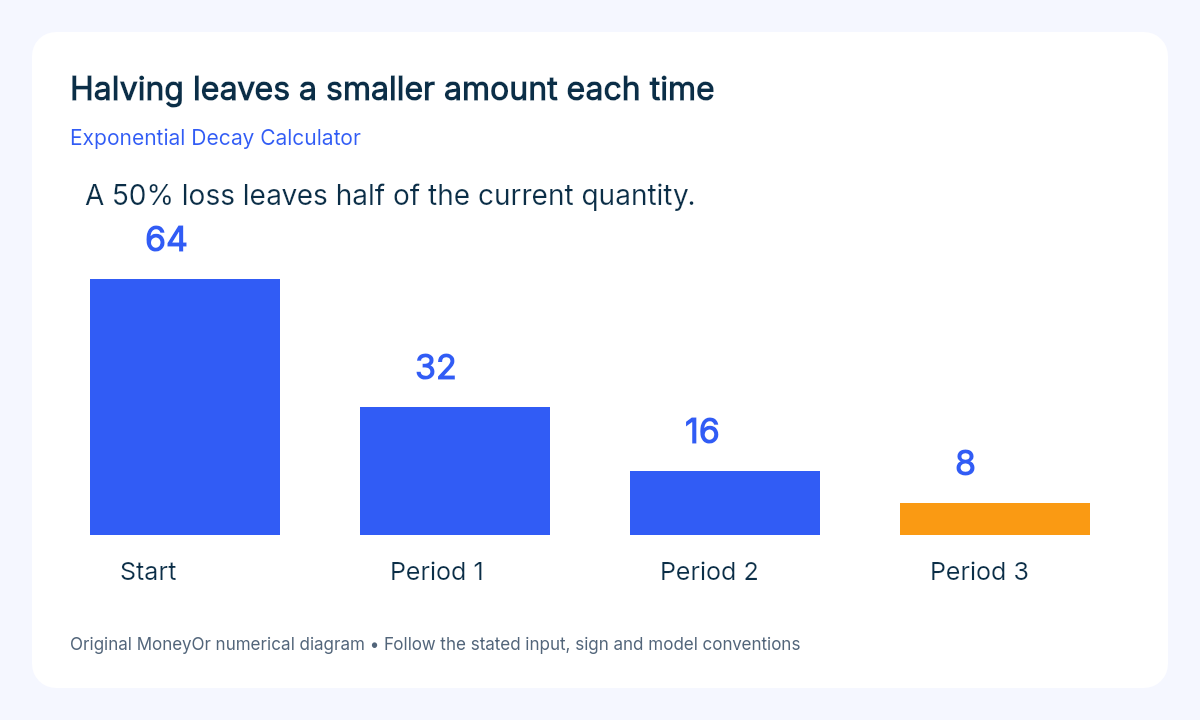
Second, 80 at twenty-five percent loss over two periods becomes 80 × 0.75 × 0.75 = 45. Third, 64 at fifty percent loss over three periods becomes 32, then 16, then 8. The exponential decay calculator returns the quantity left, not the quantity removed. Subtracting the final quantity from the initial quantity gives the positive amount removed in these examples.
Distinguish per-period loss from a continuous decay constant
The loss field is a percentage reduction over one complete period. It is not the continuous decay constant k in A × e^(-kn). For a loss fraction d/100 below one, the equivalent continuous constant is -ln(1 - d/100). A ten percent loss per period therefore does not mean the same thing as setting k to 0.1.
The exponential decay calculator does not convert a half-life into a percentage automatically. If a quantity halves every period in the chosen time unit, fifty percent is the matching loss rate for that period. If its half-life spans several of those periods, a different per-period rate is needed. Derive that rate from the stated model rather than entering the half-life itself in the percentage field.
Zero duration, complete loss and numerical boundaries
The exponential decay calculator accepts an initial quantity from zero to one trillion, loss percentage from zero to one hundred and duration from zero to ten thousand periods. Zero duration returns the initial quantity. Zero percentage loss also leaves it unchanged. At one hundred percent loss, a positive duration gives a final quantity of zero by this model's explicit boundary convention.
An initial zero remains zero, but its percentage change from the initial quantity is undefined. A loss percentage below one hundred normally leaves a strictly positive mathematical result for a positive initial quantity and finite duration. If that positive value is too small for ordinary numerical storage, the exponential decay calculator rejects it rather than incorrectly reporting an exact zero. Display rounding alone also must not be mistaken for complete depletion.
Check whether repeated proportional loss is appropriate
This exponential decay calculator assumes the same loss percentage throughout, with no replacement, additions or changing conditions. A process that removes a fixed number of units each period follows a different rule. Losing ten units repeatedly from one hundred is linear loss; losing ten percent repeatedly leaves ninety, then eighty-one, then seventy-two point nine.
Check a short example by multiplying the initial quantity by the remaining factor once for each complete period. For a positive starting quantity and loss between zero and one hundred percent, the remaining amount decreases as the period count increases. It does not become negative. A later increase of the same percentage does not automatically reverse a loss, because the increase is applied to the smaller remaining base.
For instance, a twenty percent loss leaves eighty percent of the original. Recovering the start from that smaller quantity requires a twenty-five percent increase: 0.8 × 1.25 = 1. This recovery calculation uses a different percentage base from the original loss.
Questions about exponential decay calculator
What does an exponential decay calculator return?
It returns the quantity remaining after a fixed percentage loss is applied over the specified number of periods. It also compares the final quantity with the starting quantity using signed absolute and percentage changes. The underlying model keeps one percentage constant. It does not measure real depletion or establish whether the same rate will continue.
Should the loss percentage be positive or negative?
Enter a positive loss percentage. For a ten percent reduction per period, enter ten. The exponential decay calculator subtracts that fractional rate from one to create the remaining multiplier 0.9. A negative entry would describe an increase under this convention, so it is rejected by this loss-only form rather than silently changing the meaning.
Why does five periods at ten percent loss leave more than half?
The loss is taken from the current quantity each time. Five multiplications by 0.9 leave 0.59049 of the original amount, which is 59.049 percent remaining. The total loss is 40.951 percent. Subtracting ten percent of the original amount five times would instead be a fixed numerical loss model.
Is the output the remaining amount or the amount lost?
The final quantity is the amount remaining. For an initial 1000 and final 590.49, the positive amount lost is 409.51. The signed absolute change is -409.51 because it is calculated as final minus initial. Keeping those labels separate prevents a remaining amount from being mistaken for a removed amount when interpreting or sharing the result.
Can the exponential decay calculator use fractional periods?
Yes. It raises the same remaining multiplier to a noninteger power, providing a smooth mathematical interpolation. That may be suitable for some models, but a real process may apply changes only on specific dates or use a different partial-period rule. Confirm the intended meaning of a fraction of the chosen rate period before relying on that interpolation.
What does one hundred percent loss mean?
A complete-period remaining multiplier is zero. This form returns zero for any positive period count at that boundary, and it returns the initial quantity for zero periods. That convention handles the endpoints explicitly. It is distinct from a loss below one hundred percent, where a positive initial amount stays mathematically positive for finite duration even if it becomes very small.
Can the model produce a negative remaining quantity?
Not with the supported nonnegative initial quantity, nonnegative duration and loss from zero to one hundred percent. The remaining multiplier stays between zero and one. A negative remaining quantity would indicate a different model or an invalid calculation. The exponential decay calculator rejects unsupported inputs and numerical-range failures instead of treating them as meaningful negative stock.
How does this differ from a half-life calculator?
A half-life calculator uses the time needed to halve a quantity and a compatible elapsed duration. This form takes the percentage lost per period directly. If one period equals the half-life, enter fifty percent loss. If the chosen period differs, first derive the matching percentage. Do not enter a duration value into a percentage field.
Why can a very small positive result be rejected?
Ordinary floating-point arithmetic cannot represent arbitrarily tiny positive numbers. A mathematical result may remain positive even when it falls below that range. The exponential decay calculator rejects such a case instead of reporting a false exact zero. This is a numerical limitation, distinct from the explicit one hundred percent loss case that genuinely gives zero in the model.
Can I model replenishment or a changing loss rate?
Not in a single calculation here. The model assumes no additions and one fixed loss percentage throughout the duration. Replacement, periodic top-ups and changing rates need their own amounts and timing. You can model clearly defined stages separately, carrying the remaining amount forward, but do not assume this form already includes events that were never entered.
Does an equal percentage increase reverse a loss?
Usually not. After a twenty percent loss, only eighty percent of the initial quantity remains. Increasing that remainder by twenty percent gives ninety-six percent of the original, not one hundred. The required recovery increase is twenty-five percent in that example. The exponential decay calculator reports loss relative to the original quantity, while recovery uses the smaller remaining base.
Sources and method notes
Method and source notes checked on 26 November 2026. The diagrams are original explanatory drawings. Read the privacy policy for other site services.