Exponential Growth Calculator
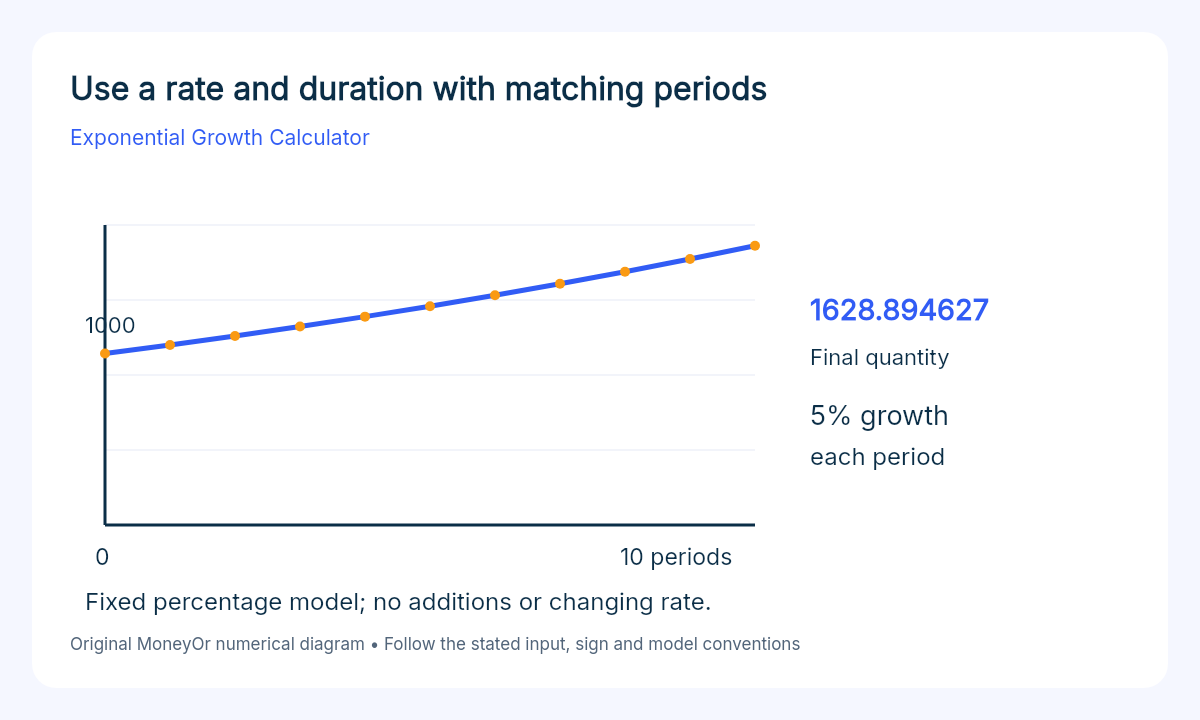
This exponential growth calculator estimates a final quantity when the same percentage change applies each period. Starting with 1000 at five percent per period for ten periods gives about 1628.894627. The percentage is applied to the changing quantity, so each period builds on the result of the previous one.
Loading calculator. JavaScript is required.
Your result
The exponential growth calculator returns the final quantity, its absolute change and its total percentage change from the initial quantity. It uses a fixed per-period multiplier rather than a measured forecast. Enter a rate and period count that use the same time basis. A rate per year needs a count of years, not a count of months.
On this page
How to use the exponential growth calculator
Enter a nonnegative initial quantity, the percentage change per period and the number of periods. Enter five for five percent, not 0.05. Calculate and compare the final quantity with the starting value. A positive rate increases the modelled quantity, while a rate between negative one hundred percent and zero represents decay.
The exponential growth calculator accepts fractional period counts as a power-function extension of the same fixed multiplier. For an annual rate and eighteen months, one and a half periods may be appropriate if that interpolation matches your model. It does not establish a calendar-day convention or assume that a real process applies partial-period changes in that way.
The fixed percentage formula
Let A be the initial quantity, r the entered percentage per period and n the period count. The final quantity is A × (1 + r/100)^n. With a five percent rate, the multiplier is 1.05. Two complete periods give A × 1.05 × 1.05, so the second increase is calculated from the already increased quantity.
The exponential growth calculator uses logarithm and exponential functions to evaluate the multiplier power, with functions intended to retain useful precision for small changes. This remains floating-point numerical arithmetic. Absolute change is final minus initial; total percentage change compares that difference with the nonzero initial quantity. The total percentage is generally different from simply multiplying the entered rate by the number of periods.
Three worked growth examples
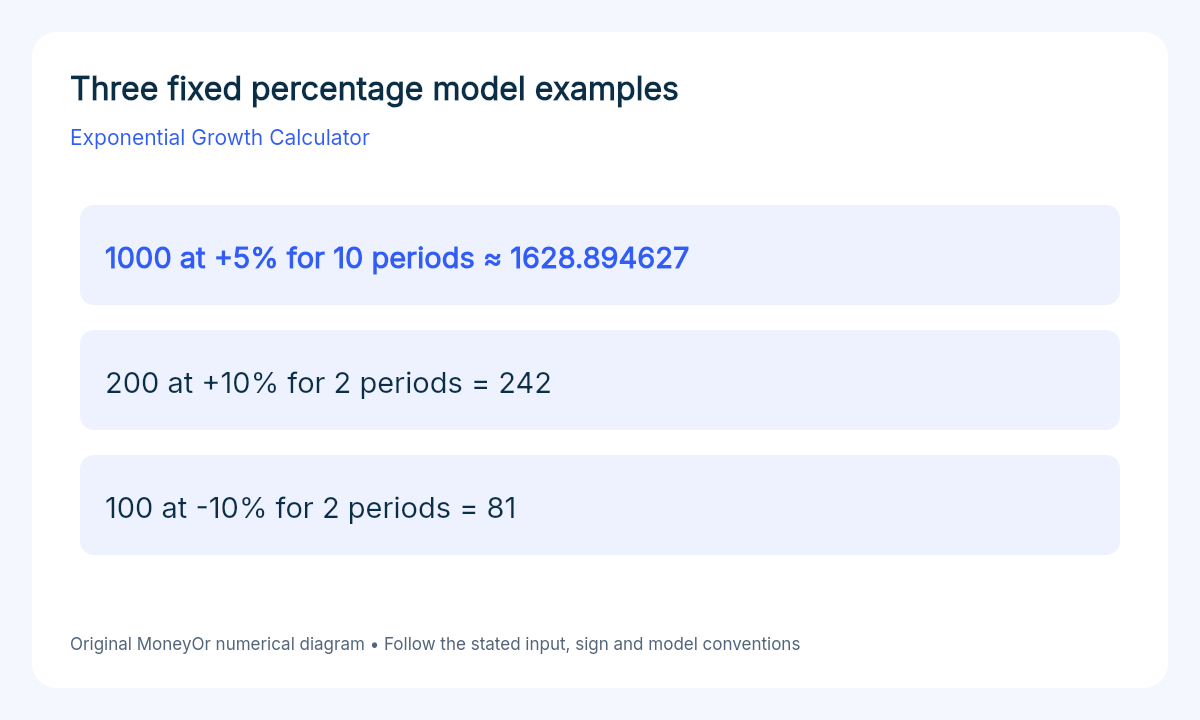
For 1000 at five percent over ten periods, the calculation is 1000 × 1.05^10. The final quantity is approximately 1628.894627, an increase of about 628.894627 or 62.889463 percent. Simple addition of ten five-percent changes to the original quantity would instead give 1500, which describes a different model.
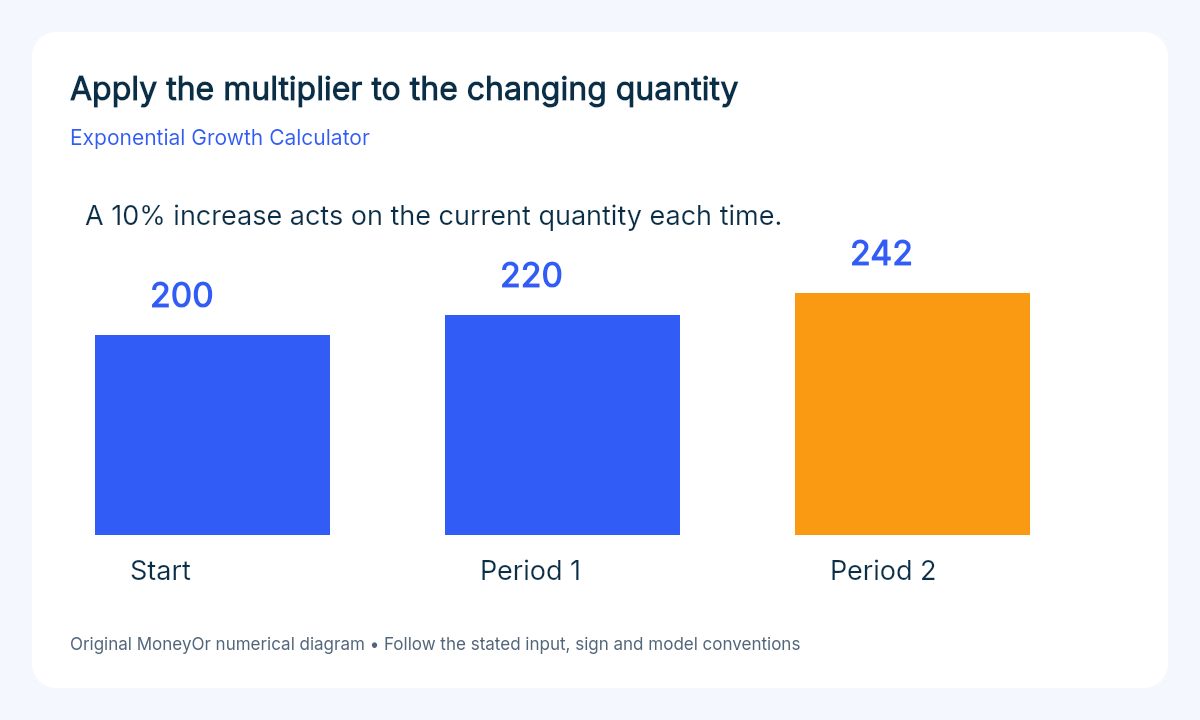
For 200 at ten percent over two periods, the first period gives 220 and the second gives 242. For 100 at negative ten percent over two periods, the multipliers are 0.9 and 0.9, giving 81. This third example shows why a negative rate accepted by the exponential growth calculator models repeated proportional loss rather than a fixed numerical subtraction each period.
Match the period and distinguish continuous rates
A five percent monthly rate and a five percent annual rate use different periods and produce different answers over a year. The exponential growth calculator does not convert between them automatically. Twelve monthly periods use the monthly multiplier twelve times. One annual period uses the annual multiplier once. Keep the period definition alongside the result when recording or sharing it.
A continuous rate k in A × e^(kn) is also different from the percentage entered here. To match a per-period multiplier 1 + r/100, the equivalent continuous rate is ln(1 + r/100), provided that multiplier is positive. Entering the same numerical percentage into both formulas does not generally describe the same curve. This form evaluates the per-period percentage model only.
Zero values and supported numerical range
The exponential growth calculator accepts an initial quantity from zero to one trillion, a rate from negative one hundred to positive one thousand percent and a period count from zero to ten thousand. A zero period count returns the initial quantity. A zero rate also leaves it unchanged. A negative one hundred percent rate makes a positive starting quantity zero after any positive modelled duration.
An initial quantity of zero remains zero in this model. Its total percentage change is undefined because that comparison would divide by zero. Very large powers can overflow ordinary numerical storage, and very small positive results can underflow it. The exponential growth calculator rejects an out-of-range positive final result rather than presenting infinity or silently replacing a tiny positive quantity with zero.
Check whether the growth model fits
This exponential growth calculator assumes one unchanged rate and no additions or removals between periods. If a balance receives deposits, a population faces a capacity limit or a process changes rate, a single fixed multiplier may be an incomplete description. The form does not infer those events or fit a rate from observed data.
To check an answer for whole periods, multiply the starting quantity by the same factor repeatedly for a small test case. For a positive initial quantity and positive rate, the final quantity should increase with the period count. A ten percent increase followed by a ten percent decrease does not restore the original quantity: multiplying 1.1 by 0.9 gives 0.99. Retain that distinction when interpreting percentage changes.
Questions about exponential growth calculator
What does an exponential growth calculator assume?
It assumes a constant percentage change per period, applied repeatedly to the changing quantity, with no separate deposits, withdrawals or external additions. The initial quantity, rate and period count are supplied by you. The output is the result of that model. It is not evidence that a real quantity will follow the same path.
Should I enter five or 0.05 for five percent?
Enter five. The exponential growth calculator divides the percentage field by one hundred internally, producing a fractional rate of 0.05 and multiplier 1.05. Entering 0.05 would mean 0.05 percent per period instead. Confirm the rate unit and its period before interpreting a small or unexpectedly large final quantity.
Why is ten periods at five percent more than fifty percent total?
The increase in each later period is based on a quantity that has already grown. The multiplier 1.05 is applied ten times, giving about 1.628894627 times the original amount. That represents about 62.889463 percent total growth. Adding ten increases calculated only from the initial amount would be a different, linear model.
Can the exponential growth calculator model a negative rate?
Yes. Rates from negative one hundred percent to zero are accepted as a proportional-loss model. At negative ten percent, the per-period multiplier is 0.9. A quantity of 100 becomes 81 after two periods. Rates below negative one hundred percent would create a negative multiplier and are outside this nonnegative-quantity model.
Does one period mean one year?
Only if the entered rate is a yearly rate. A period may represent a day, month, year, generation or another interval. The rate and period count must use that same definition. The exponential growth calculator does not inspect a date, infer a time unit or automatically convert a monthly percentage into an annual percentage.
What does a fractional period count mean?
It evaluates the same multiplier raised to a noninteger power. For a positive multiplier, this provides a smooth mathematical extension between complete periods. A real contract or process may use a different partial-period rule. Use fractional periods only when that power-function interpretation matches your intended model, rather than assuming every real system follows it.
Is this the same as using a continuous growth rate?
No. This form uses a percentage that produces the multiplier 1 + r/100 each period. A continuous-rate formula uses e raised to a rate-times-duration product. For a positive multiplier, the equivalent continuous rate is its natural logarithm. Equal numerical rate entries in the two models generally give different results.
What happens with an initial quantity of zero?
Zero multiplied by any supported finite model factor remains zero. The absolute change is zero, but the percentage change from an initial zero is undefined. The exponential growth calculator leaves that percentage comparison undefined rather than dividing by zero. This model does not add an external contribution that could move a zero quantity above zero.
Why might a very large or tiny result be rejected?
Floating-point arithmetic has a finite range. The calculator checks whether the positive final quantity can be represented rather than returning infinity or a false zero. Supported input fields do not guarantee that every possible combination produces a supported output. Reduce the model horizon or rate only if that remains appropriate to the actual problem.
Can I include regular contributions or changing rates?
Not in this form. The exponential growth calculator applies one rate to one starting quantity over the specified duration. Contributions, removals, fees and rate changes require additional timing and amount rules. Work through separate periods with a suitable model, or use a calculator specifically designed for those cash flows instead of treating this result as if they were included.
How can I check the default result?
Multiply 1000 by 1.05 ten times, or evaluate 1000 × 1.05^10 independently. The final quantity is approximately 1628.894627, and subtracting 1000 gives approximately 628.894627. Dividing that change by 1000 and multiplying by one hundred gives approximately 62.889463 percent. Small final-digit differences can occur because the arithmetic is numerical.
Sources and method notes
Method and source notes checked on 26 November 2026. The diagrams are original explanatory drawings. Read the privacy policy for other site services.