Fraction Calculator
This fraction calculator combines two numerical fractions with addition, subtraction, multiplication or division. Enter each numerator and denominator separately, then choose the operation. With 3/4 and 1/2, addition gives 5/4, also written 1 1/4. The decimal value in this example is 1.25.
Loading calculator. JavaScript is required.
Your result
The fraction calculator reduces its rational result and keeps the denominator positive. Signed whole-number and supported finite-decimal components are accepted. Both denominators must be nonzero, and division also requires the second fraction to be nonzero. The exact fraction remains available separately from the decimal approximation so you can choose the form your next calculation needs.
On this page
How to use the fraction calculator
Enter the first fraction as numerator a over denominator b, then the second as c over d. Choose Add, Subtract, Multiply or Divide before calculating. Preserve negative signs. Use decimal points without grouping commas, and enter components rather than typing a complete expression such as 3/4 into one field.
The fraction calculator performs one selected operation at a time. For subtraction, it takes the second fraction away from the first. For division, it divides the first by the second. Reversing those inputs can change the result. Addition and multiplication have the same result when the two fractions are swapped, which supplies a useful check for those operations.

The four fraction operation formulas
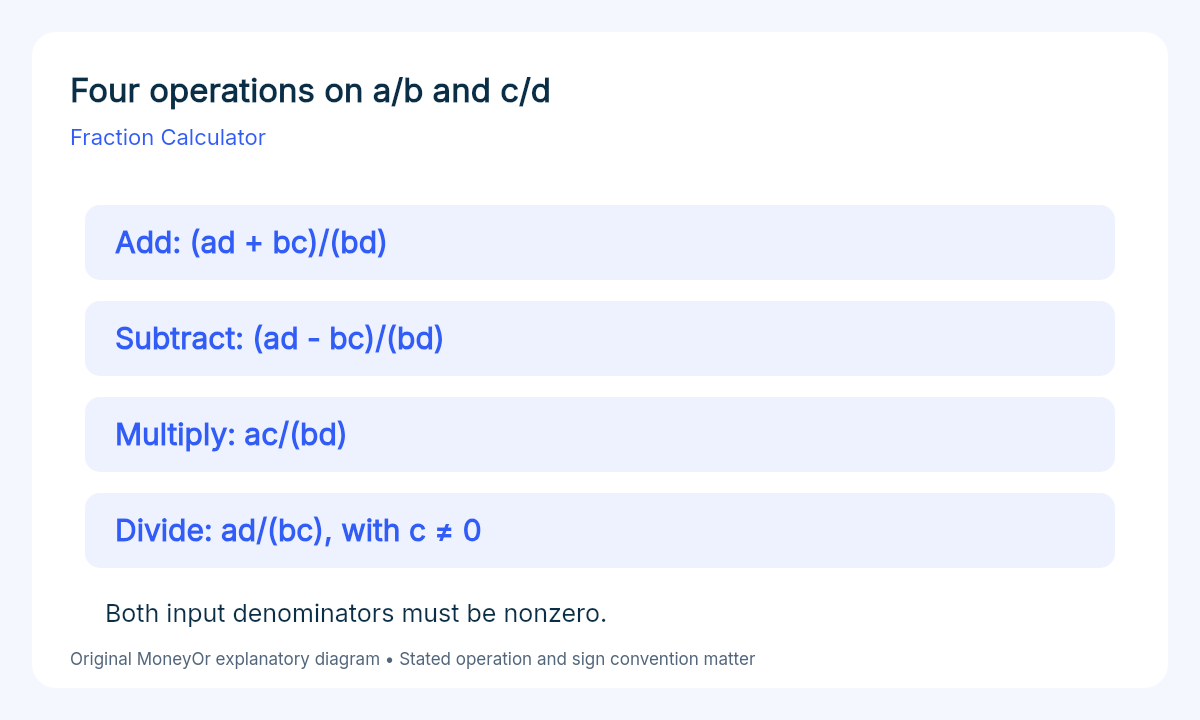
For a/b and c/d, addition gives (ad + bc)/(bd), while subtraction gives (ad - bc)/(bd). The common denominator describes equal-sized parts before the numerators are combined. Do not add denominators to add fractions. For 3/4 plus 1/2, convert the half to 2/4 and add three fourths to two fourths.
Multiplication gives ac/(bd). For 3/4 times 1/2, this produces 3/8. Division multiplies by the reciprocal of the second fraction, giving ad/(bc), provided c is nonzero. The fraction calculator reduces the resulting ratio by its greatest common factor and moves any remaining negative sign to the numerator.
Three worked fraction examples
Example one adds 3/4 and 1/2. Rewriting one half as two fourths gives 3/4 + 2/4 = 5/4. This improper fraction is also 1 1/4, and its terminating decimal is 1.25. A result larger than one is permitted; the calculator does not force an improper fraction into a smaller, inequivalent value.
Example two subtracts 1/2 from 3/4. In fourths, the operation is 3/4 - 2/4 = 1/4. Swapping the fractions would give negative one fourth instead. Keeping the operation and input order with the answer helps another person distinguish those two different subtraction problems.
Example three divides 3/4 by 1/2. Multiply three fourths by the reciprocal 2/1 to obtain 6/4, then reduce to 3/2. The mixed form is 1 1/2 and the decimal is 1.5. Division by a positive fraction smaller than one can increase the result, so an answer larger than the first fraction is not automatically an error.

Fraction calculator signs, zero and mixed form
The fraction calculator normalizes a negative denominator without changing the value. Three over negative four is the same as negative three over four. Two negative signs within a fraction cancel. A zero numerator is valid with a nonzero denominator, and a zero result is represented as 0/1 in reduced fraction form. For example, adding 3/4 and -3/4 produces 0/1; the opposite signed quantities cancel exactly. Their denominators remain valid throughout that cancellation.
Dividing by a zero fraction is rejected even when its denominator is nonzero. A result such as -5/2 may be shown as -2 1/2; the leading minus sign applies to the whole mixed quantity. A proper negative fraction remains a fraction rather than being written with a negative zero whole part. Use the exact reduced fraction if mixed-number notation could be misunderstood.
Fraction calculator precision and decimal components
The fraction calculator accepts component magnitudes up to 1,000,000,000,000 with at most twelve effective decimal places after normalization. Trailing zeros do not add precision. Supported scientific notation has an exponent from negative twenty-four to positive twenty-four, subject to the same normalized magnitude and decimal-place limits.
Within that scope, finite decimal components are converted to exact integer ratios before the operation. For 2.5 over 5, the first fraction is exactly 1/2 in the entered decimal model. A rounded measurement remains the value you entered; the calculator cannot recover hidden digits. The decimal approximation can round a repeating result even though the accompanying reduced numerator and denominator retain the exact rational value.
Check the result and keep its context
For addition, subtracting the second fraction from the result should recover the first. For multiplication, dividing the result by a nonzero second fraction should recover the first. These inverse checks are useful alongside an estimate of the expected sign and size. Keep exact fractions during the check when a repeating decimal would introduce rounding.
This fraction calculator handles numerical components rather than variables, mixed-number text expressions or a sequence of operations with brackets. It does not infer units or decide which operation a word problem requires. Preserve both original fractions and the chosen operation with a copied result. When opening CSV files in a spreadsheet, keep fraction-text columns as text so a value such as 1/3 is not silently interpreted as a date.
Questions about fraction calculator
Which operations does the fraction calculator support?
It supports addition, subtraction, multiplication and division of two numerical fractions. Select the operation explicitly after entering both numerator-denominator pairs. Subtraction takes the second fraction from the first, and division takes the first fraction divided by the second. The form performs one operation at a time rather than parsing a larger expression with several operators and brackets.
Why do I need a common denominator for addition?
The denominator defines the size of the fractional parts. Before adding counts of those parts, express both fractions in equal-sized parts. For 3/4 plus 1/2, one half equals two fourths, so the sum is five fourths. Adding the original numerators and denominators separately would give 4/6, which does not represent the same addition problem.
Does multiplying fractions require a common denominator?
No. Multiply the two numerators and the two denominators, then reduce the result. For 3/4 times 1/2, the numerator is three and the denominator is eight. Common factors can sometimes be cancelled before multiplication, but cancellation must preserve the complete product. The calculator returns the reduced rational value rather than an unnecessarily large unreduced ratio.
Why does division use the second fraction's reciprocal?
Dividing by a nonzero value is multiplication by its reciprocal. The reciprocal of c/d is d/c, provided c is nonzero. Therefore a/b divided by c/d becomes ad/(bc). For 3/4 divided by 1/2, multiplication by 2/1 gives 6/4, reducing to 3/2. A second numerator of zero makes that reciprocal undefined and is rejected.
Can I use negative fractions or denominators?
Yes. Keep each sign with its entered component. A negative denominator is normalized to a positive one by changing the numerator sign as well. Three over negative four equals negative three over four, and negative three over negative four is positive. The final mixed form, when negative, applies its leading minus sign to the entire mixed quantity.
What happens if a numerator or denominator is zero?
A zero numerator is valid when its denominator is nonzero and represents zero. A zero denominator is invalid. The second fraction may be zero for addition, subtraction or multiplication, but not as the divisor in a division operation. A reduced zero result is 0/1, which is different from an invalid input expression 0/0.
Are decimal numerator and denominator values exact?
Supported finite decimal components are treated as exact decimal inputs before conversion to rational form. For example,2.5/5 becomes 1/2 exactly in that model. This does not infer a repeating decimal or recover measurement digits that were not entered. The separate decimal approximation of the final fraction can still round when the result has an infinite decimal expansion.
Can I type a mixed number such as 2 1/3 into a field?
No. Enter numerical components in the separate fields. Convert the mixed number to an improper fraction first: two and one third is 7/3. If it is negative two and one third, enter negative seven over three. The calculator can show a mixed form of the result, but it does not parse a space-separated mixed-number input expression.
Why can division by a fraction make the answer larger?
Dividing by a positive fraction smaller than one asks how many of those smaller portions fit into the first value. Three fourths contains one and a half portions of size one half, so 3/4 divided by 1/2 equals 3/2. Estimate the size before calculating, and keep sign rules separate when either input fraction is negative.
Which form should I keep for later calculations?
Keep the reduced fraction when exact rational arithmetic matters. A mixed form can be easier to read, while a decimal approximation can be convenient for comparison or a task that already permits rounding. A repeating fraction such as 1/3 cannot be fully represented by a finite displayed decimal. Keep the original operation and input fractions with the selected output form.
How should I handle fraction values in a CSV or spreadsheet?
The CSV records the current results rather than a complete input history. Preserve the two original fractions and the selected operation separately. Import fraction-text columns as text when needed, because spreadsheet software may interpret a string such as 1/3 as a date. Keep the exact numerator and denominator columns if the receiving application would otherwise round a long numeric value.
Sources and method notes
Method and source notes checked on 26 November 2026. The diagrams are original explanatory drawings. Read the privacy policy for other site services.