Mixed Fraction Calculator
This mixed fraction calculator performs one arithmetic operation on two signed mixed quantities. Enter one and a half plus three quarters to obtain the exact fraction 9/4, also written as 2 1/4. Each quantity has separate fields for its sign, whole part, fractional numerator and denominator.
Loading calculator. JavaScript is required.
Your result
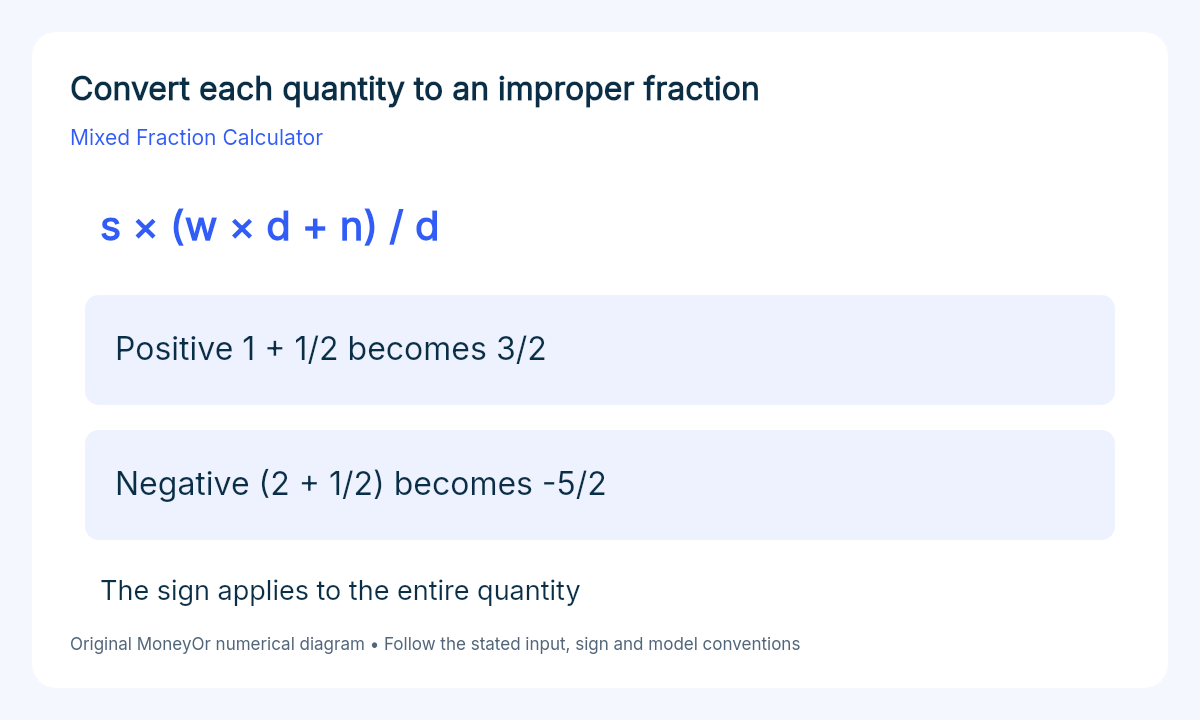
The mixed fraction calculator interprets a negative sign as applying to the complete quantity. Negative two and a half means -(2 + 1/2), which equals -5/2. This matters when the whole part is zero: choosing Negative with numerator one and denominator two still gives -1/2. The sign is never inferred from a negative zero.
On this page
- How to use the mixed fraction calculator
- Convert each mixed quantity before operating
- Three examples with the same two quantities
- Read the exact and approximate results
- Component limits and invalid entries
- Keep units and the operation in context
- Questions about mixed fraction calculator
- Sources and method notes
How to use the mixed fraction calculator
Choose the sign of the first quantity, then enter its nonnegative whole part, numerator and positive denominator. Repeat for the second quantity. Select Add, Subtract, Multiply or Divide, then calculate. For subtraction and division, the first quantity is the left operand, so swapping the two quantities generally changes the result.
To enter an ordinary fraction, use a zero whole part. To enter a whole number, use a zero numerator and any valid positive denominator, such as one. Do not enter a slash or the letter i in a component field. This mixed fraction calculator accepts numerical components separately rather than parsing a written expression.
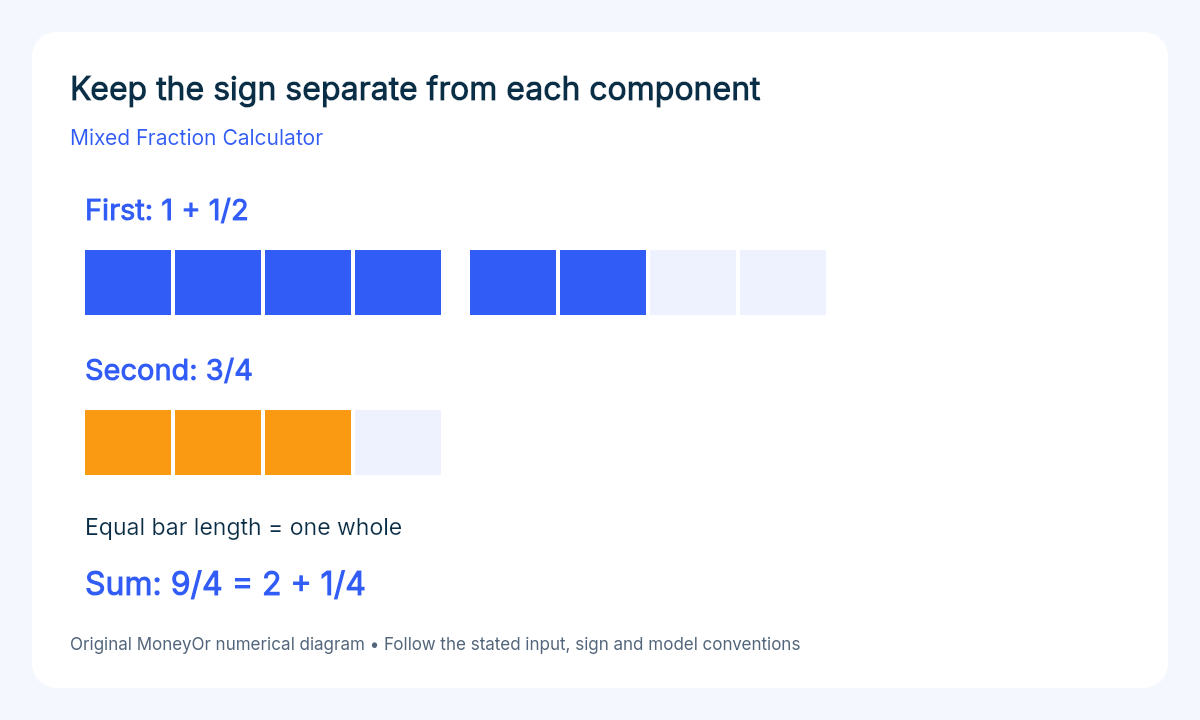
Convert each mixed quantity before operating
For sign s, whole part w, numerator n and denominator d, the corresponding improper fraction is s × (w × d + n)/d. The sign is either positive one or negative one. With whole part one, numerator one and denominator two, the conversion gives 3/2. A negative sign would give -3/2 instead.
The mixed fraction calculator then operates on the two converted fractions. Addition and subtraction use a common denominator. Multiplication multiplies numerators and denominators. Division multiplies the first fraction by the reciprocal of the second, provided that second quantity is nonzero. The resulting numerator and denominator are divided by their greatest common factor, with any remaining minus sign kept in the numerator.
Three examples with the same two quantities
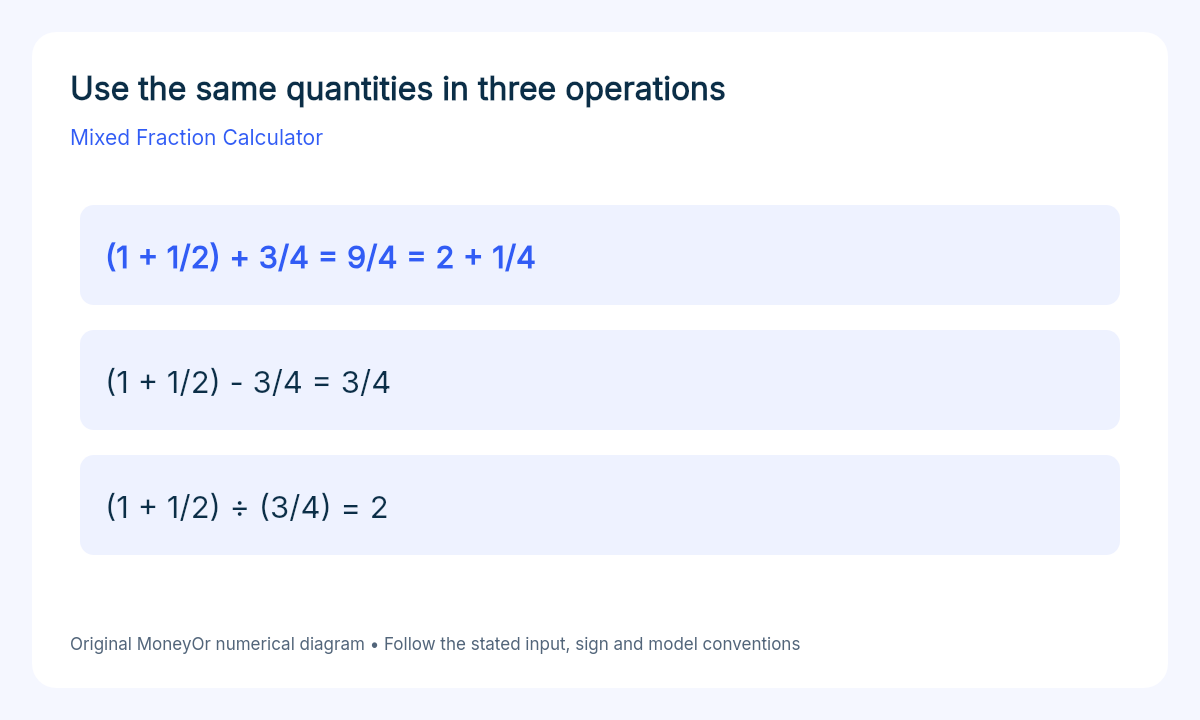
Start with first quantity 1 1/2 and second quantity 3/4. For addition, convert them to 3/2 and 3/4. Rewriting 3/2 as 6/4 gives 6/4 + 3/4 = 9/4. The mixed answer is 2 1/4, meaning two complete units plus one quarter of another unit.
For subtraction, use 6/4 - 3/4 = 3/4. The whole part of the answer is zero, so the exact fraction is already the simpler notation. For division, use (3/2) × (4/3) = 12/6 = 2. Division asks how many groups of three quarters fit into one and a half. These examples use the same entries but different operations.
Read the exact and approximate results
The mixed fraction calculator returns a reduced exact fraction and a mixed representation. If the answer is a whole number, the mixed representation is that integer. A proper fraction does not need an extra zero whole part. For a negative improper result such as -9/4, the mixed display -2 1/4 means negative two and one quarter together.
A separate decimal approximation may be useful for comparison. It is not always an exact replacement for the fraction: 1/3 repeats indefinitely in decimal notation. Keep the reduced fraction when continuing exact arithmetic. A display rounded to a selected number of places cannot recover digits that it no longer shows, even though the underlying rational result remains available.
Component limits and invalid entries
Each whole part, numerator and denominator must be a whole number from zero to 1,000,000,000,000, and denominators must be greater than zero. These are individual component limits. The converted improper numerator may exceed that bound because multiplying a whole part by its denominator is an internal integer operation. The mixed fraction calculator performs that arithmetic with exact integers.
An entered fractional numerator may equal or exceed its denominator; the quantity is normalized rather than rejected for being improper. Negative component values are rejected because the separate sign applies to the whole quantity. Division by a zero second quantity is invalid, including a second entry with both whole part and numerator zero. A zero first quantity can still be divided by any nonzero second quantity.
Keep units and the operation in context
This mixed fraction calculator handles numerical arithmetic, so retain any units from the original problem. Adding one and a half metres to three quarters of a metre gives two and a quarter metres. Multiplying two lengths would give an area instead. The calculator does not assign units or decide whether two quantities are compatible.
Check a subtraction result by adding the second quantity back to the answer. Check a division result by multiplying it by the nonzero divisor. When comparing this mixed fraction calculator with a handwritten expression, first confirm the sign convention and order of operands. Parentheses around a negative mixed quantity can remove ambiguity before any arithmetic begins.
For example, subtracting positive three quarters from negative one and a half gives -6/4 - 3/4 = -9/4. Adding the positive three quarters back gives -6/4, which is the original negative one and a half. This check catches a mistaken sign without relying on a rounded decimal.
Questions about mixed fraction calculator
What does a mixed fraction calculator calculate?
It applies one selected operation to two quantities written as a whole part plus a fraction, with a separate sign for each complete quantity. The answer is reduced to an exact fraction and also shown in mixed form. Ordinary fractions and integers fit the same fields by setting the whole part or numerator to zero.
How do I enter a negative quantity below one?
Choose Negative, enter zero as the whole part, and enter the positive numerator and denominator. For negative three quarters, use zero, three and four. The separate sign makes the meaning explicit even when there is no nonzero whole part to carry a visible minus sign. Do not put another negative sign in a component field.
Why does negative two and a half equal -5/2?
The sign applies to the complete mixed quantity, so the interpretation is -(2 + 1/2). This equals -2.5 or -5/2. The different expression -2 + 1/2 equals -1.5. Use parentheses when writing the mixed quantity in another system if the placement of the sign might be misunderstood.
Can the fractional numerator exceed the denominator?
Yes. With whole part one and fractional part 5/2, the quantity is 1 + 5/2 = 7/2. The mixed fraction calculator normalizes that value to 3 1/2 when needed. All entered components must still satisfy the whole-number and magnitude limits; accepting an improper fractional part does not permit a zero denominator.
What happens when I multiply the default quantities?
The default first quantity is 1 1/2, which becomes 3/2, and the second is 3/4. Multiplication gives 9/8, or 1 1/8. This differs from addition, whose answer is 9/4. Always check the selected operation before calculating or copying a result, particularly after changing the dropdown while keeping the same inputs.
Can this mixed fraction calculator divide by zero?
No. A divisor with zero whole part and zero numerator has value zero regardless of its valid positive denominator. Dividing by that quantity is undefined and is rejected. A nonzero numerator or whole part makes the second quantity nonzero. A zero first quantity divided by a nonzero second quantity is valid and gives zero.
Are decimals accepted in the component fields?
The components represent integer counts, so nonintegral decimals are rejected. An entry equivalent to an integer, such as 2.0, can normalize to that same whole number. To calculate with finite decimal numerator or denominator values directly, use the separate Fraction Calculator. This form uses mixed whole and fractional parts to make the sign and structure visible.
Does a reduced fraction lose any of the value?
No. Dividing both numerator and denominator by their common factor preserves the ratio. For example, 18/8 and 9/4 are exactly equal. The reduced form uses smaller integers and a positive denominator. A separate finite decimal approximation can involve rounding, but that does not alter the exact rational result displayed alongside it.
How can I check an addition result?
Convert each original quantity into an improper fraction, put the fractions over a common denominator and add their numerators. With 1 1/2 and 3/4, that becomes 6/4 + 3/4 = 9/4. You can also subtract the second quantity from the answer and check that the first quantity is recovered exactly.
Why are the component limits separate from the answer size?
The form bounds each entered integer to keep the supported workload clear. Conversion can multiply a whole part by its denominator, and later fraction operations can create larger intermediate integers. Exact integer arithmetic handles those derived values within this bounded input model. The result is not restricted to the original single-component maximum.
Can I paste an expression into the mixed fraction calculator?
No. Use the separate sign, whole-part, numerator, denominator and operation controls. The form does not parse brackets, chained arithmetic, variables or a sentence containing units. Work through a longer calculation one operation at a time while retaining exact fraction results, or use a suitable expression parser whose rules you have checked.
Sources and method notes
Method and source notes checked on 26 November 2026. The diagrams are original explanatory drawings. Read the privacy policy for other site services.