Sphere Volume Calculator
This sphere volume calculator uses a radius to find the volume, surface area and diameter of a complete sphere. Enter the distance from the centre to the surface. With a radius of 3 centimetres, the sphere has a volume of about 113.09733553 cubic centimetres, a surface area of about 113.09733553 square centimetres and a diameter of 6 centimetres.
Loading calculator. JavaScript is required.
Your result
Use the sphere volume calculator for an ideal ball-shaped object or a geometry exercise. It does not model a hemisphere, an ellipsoid or the empty space inside a hollow shell. If you measured across the whole sphere, divide that diameter by two before entering the radius.
On this page
- Sphere volume calculator radius inputs
- Sphere volume and surface area formulas
- Three worked examples
- Check how size changes the result
- Precision and real-world limitations
- Sphere Volume Calculator: Choose inside or outside measurements deliberately
- Questions about sphere volume calculator
- Sources and method notes
Sphere volume calculator radius inputs
Radius is half of diameter. Confusing them has a large effect because the volume formula cubes the radius. If a ball is 10 inches across, enter a radius of 5 inches. Entering 10 as the radius would describe a sphere twice as wide and eight times the volume of the measured one.
Select the unit that matches your radius. The selection labels the result but does not convert the number. Radius in metres produces volume in cubic metres and surface area in square metres. If you want another unit, convert the radius before calculating or use the volume converter on the completed volume. Enter ungrouped decimal numbers with a decimal point.

Sphere volume and surface area formulas
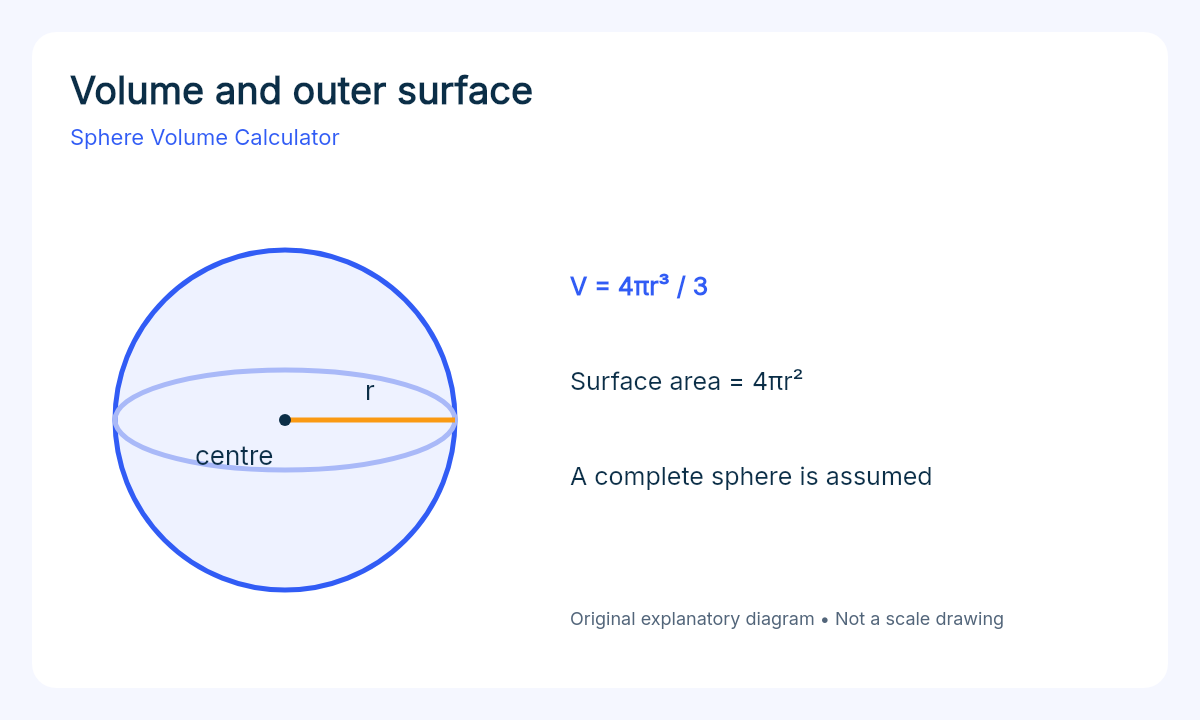
Volume = 4 × π × r³ / 3, where r is radius. Surface area = 4 × π × r², and diameter = 2 × r. The sphere volume calculator uses the browser's Math.PI value rather than a shortened input such as 3.14. Multiplying radius three times produces a cubic unit; multiplying it twice produces a square unit.
Volume measures the three-dimensional space enclosed by the spherical surface. Surface area measures the outer boundary itself. The same numerical result can occasionally appear for both quantities, but their units and meanings remain different. A volume is not a weight or mass. To estimate mass for a uniform solid, you would also need a suitable density expressed in compatible units.
Three worked examples
Example one uses r = 3 centimetres. Volume is 4 × π × 27 / 3 = 36π, approximately 113.09733553 cubic centimetres. Surface area is 4 × π × 9 = 36π, approximately 113.09733553 square centimetres. Diameter is 6 centimetres. The matching numerical values arise from this particular radius and do not make area and volume interchangeable.
Example two starts from a diameter of 10 metres. First divide by two to get r = 5 metres. Volume is 500π / 3, approximately 523.59877560 cubic metres. Surface area is 100π, approximately 314.15926536 square metres. The output diameter of 10 metres confirms that the radius was entered correctly.
Example three uses r = 0.5 inches. Volume is π / 6, approximately 0.52359878 cubic inches. Surface area is π, approximately 3.14159265 square inches. Diameter is 1 inch. These smaller dimensions are handled by the same formulas without changing the unit label or assuming that a decimal radius represents a fraction of some other unit.

Check how size changes the result
Doubling radius doubles diameter, multiplies surface area by four and multiplies volume by eight. This scaling rule is a useful independent check. It also explains why a modest increase in a ball's outside dimensions can mean a much larger enclosed volume. A 6 centimetre radius sphere holds eight times the geometric volume of a 3 centimetre radius sphere.
For a complete sphere, volume divided by surface area equals r / 3 when both are expressed in compatible units. You can use that relationship to check a result without recalculating both formulas from scratch. If your measured object has a flat end, an opening or noticeably different widths in different directions, first reconsider whether a complete sphere is a suitable model.
Precision and real-world limitations
The radius must be between 0.000000001 and 1,000,000,000. Blank entries, zero, negative values and numbers outside the supported range are rejected. Results normally display up to eight decimal places. Very small or very large values use scientific notation with up to six decimal places in its mantissa. Finite browser precision remains a limit even when many digits are shown.
Measurement uncertainty is often larger than arithmetic rounding. A small percentage error in radius leads to roughly three times that percentage error in volume for small changes. Measure carefully and round to a precision justified by the measurement. Copy uses the displayed values, while CSV saves the represented numerical values and their unit labels for further work.
This calculation runs in your browser without sending the radius to a calculation service. Changing the radius or display choice hides the previous result until you calculate again. Reset restores the sample radius. A hollow object requires separate inner and outer dimensions to find its material volume. Capacity, pressure limits, wall thickness and manufacturing tolerances need additional information. The ideal spherical volume alone does not establish a container's safe usable capacity or a product's material requirements.
Sphere Volume Calculator: Choose inside or outside measurements deliberately
The sphere volume calculator describes the region enclosed by the radius you enter. An outside radius gives the ideal outside volume of a spherical object. For a hollow shell, finding material volume requires a separate inner radius and subtraction of the two enclosed volumes. Neither wall thickness nor an empty interior can be inferred from the single radius field.
For a useful check with the sphere volume calculator, write down whether your measurement was radius or diameter before entering it. If a ball measures 10 centimetres across, radius is 5 centimetres and the output diameter should return 10. This simple check can prevent an eightfold volume error caused by confusing the two measurements.
Questions about sphere volume calculator
Can I enter a diameter directly?
No. Divide diameter by two, then enter the resulting radius. The output diameter helps check your input.
Does this calculate a hemisphere?
No. It reports a complete sphere. A hemisphere has half its volume, but its total surface area depends on whether the flat circular face is included.
Does volume give the weight of a ball?
No. Weight or mass requires additional information such as material density and whether the object is hollow.
Why does doubling radius multiply volume by eight?
Radius is cubed in the volume formula. Multiplying each of its three factors by two multiplies the result by 2 × 2 × 2.
Does surface area include an inner shell?
No. This model reports the outer surface of one complete mathematical sphere.
Can the sphere volume calculator find a hollow shell's material volume?
Not from one radius alone. Find the outer enclosed volume and inner enclosed volume separately, then subtract the latter from the former using compatible units. This requires the correct inner and outer dimensions. A single outside radius does not reveal wall thickness, and outer surface area does not include an additional inner surface.
Why can the sphere volume calculator show equal numbers for area and volume?
With a numerical radius of 3 in the chosen length unit, both formulas produce the number 36π. Area is still measured in square units and volume in cubic units. Their numerical equality in that unit does not make the quantities interchangeable. Changing the unit or the radius generally changes that coincidence.
Does the sphere volume calculator accept an oval ball?
It assumes a complete sphere with one common radius in every direction. An object with noticeably different widths along different axes is better represented by another model, such as an ellipsoid. Averaging those widths and entering half the average is an additional approximation chosen by you, not a measurement rule implemented by this tool.
How does radius uncertainty affect the volume?
For a small relative change in radius, the relative change in volume is approximately three times as large because volume contains radius cubed. Exact changes follow the cube of the scale factor. If radius increases by 10 percent, volume multiplies by 1.1 cubed, or 1.331, giving a 33.1 percent increase rather than exactly 30 percent.
Can I read cubic centimetres as millilitres?
For geometric volume, one cubic centimetre corresponds to one millilitre. Keep the distinction between ideal enclosed volume and a physical container's usable capacity. Wall dimensions, openings, fittings and fill level can matter in practice. The calculator reports cubic length units and does not independently verify a vessel's capacity or safe operating conditions.
Does the CSV contain an exact value of pi?
No. It exports numerical values represented by ordinary browser arithmetic. The formulas use Math.PI, which is a finite approximation, and the file may retain more digits than the formatted result display. An exact symbolic answer such as 36π should be kept separately when that form is required for a mathematical exercise.
Sources and method notes
Method and source notes checked on 26 November 2026. The diagrams are original explanatory drawings. Read the privacy policy for other site services.