Waist-to-height ratio calculator with centimetre inputs
Try Waist-to-Height Ratio Calculator
Loading calculator. If this message stays visible, enable JavaScript and reload.
Your result
The waist-to-height ratio calculator divides waist circumference by height. Enter both measurements in centimetres, then calculate the ratio. For example, an 80-centimetre waist and a height of 170 centimetres give about 0.47058824.
The output is a numerical screening ratio, not a diagnosis or a body-fat percentage. This MoneyOr form does not assign a risk category, check whether the measurement is clinically appropriate or recommend a target waist size. Use it to check the arithmetic, with the measurement method and any health interpretation considered separately.
On this page
- Waist-to-Height Ratio Calculator dimensionless quotient
- Waist-to-Height Ratio Calculator matching centimetre inputs
- Waist-to-Height Ratio Calculator waist divided by height
- Waist-to-Height Ratio Calculator unit consistency checks
- How much does the measurement method matter?
- What does the half-height reference mean?
- How does this differ from BMI, BMI prime or a waist-to-hip ratio?
- Why might my result differ from another calculation?
- Frequently asked questions
- Sources and method notes
Waist-to-Height Ratio Calculator guide and examples
Waist-to-Height Ratio Calculator dimensionless quotient
The waist-to-height ratio calculator divides waist circumference by height. The two inputs are labelled Waist circumference (cm) and Height (cm). There is no age, weight, sex or body-fat field, and the result is a ratio without a physical unit.
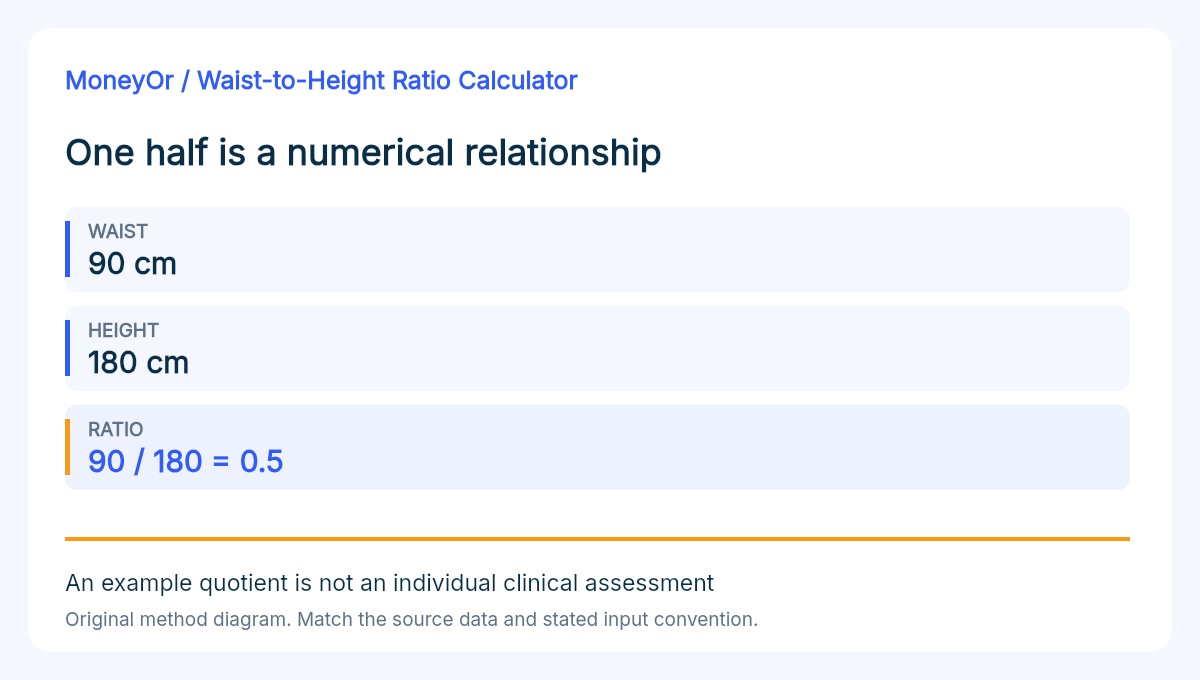
The ratio describes the numerical relationship between the two measurements. A value of 0.5 means the waist circumference is half the height. A value of 0.4 means it is four tenths of the height. Neither statement measures body-fat percentage directly.
The Waist-to-Height Ratio Calculator does not produce a colour chart, classify a body shape or calculate a disease probability. It also does not decide whether a person should lose weight. Those claims would go beyond the inputs and output of this implementation.
The BMI Calculator answers a different question using weight and squared height. Waist-to-height ratio uses circumference and height, so the two results should be kept labelled rather than compared as though their raw numbers shared a scale.
Use the ratio as one piece of screening information where appropriate. A completed calculation confirms that a division was performed on the supplied values; it does not verify the measurements or establish the health of the person they concern.
Waist-to-Height Ratio Calculator matching centimetre inputs
Use centimetres in both fields. If a measurement is available in another unit, convert it before entering it. The Length Converter can help with its supported units; the ratio form does not offer a unit-selection menu.
- Obtain waist circumference using an appropriate measurement method.
- Obtain height and check its unit.
- Convert both values to centimetres if needed.
- Enter the numbers in their matching fields.
- Choose Calculate / Run and keep the result with the original measurements.
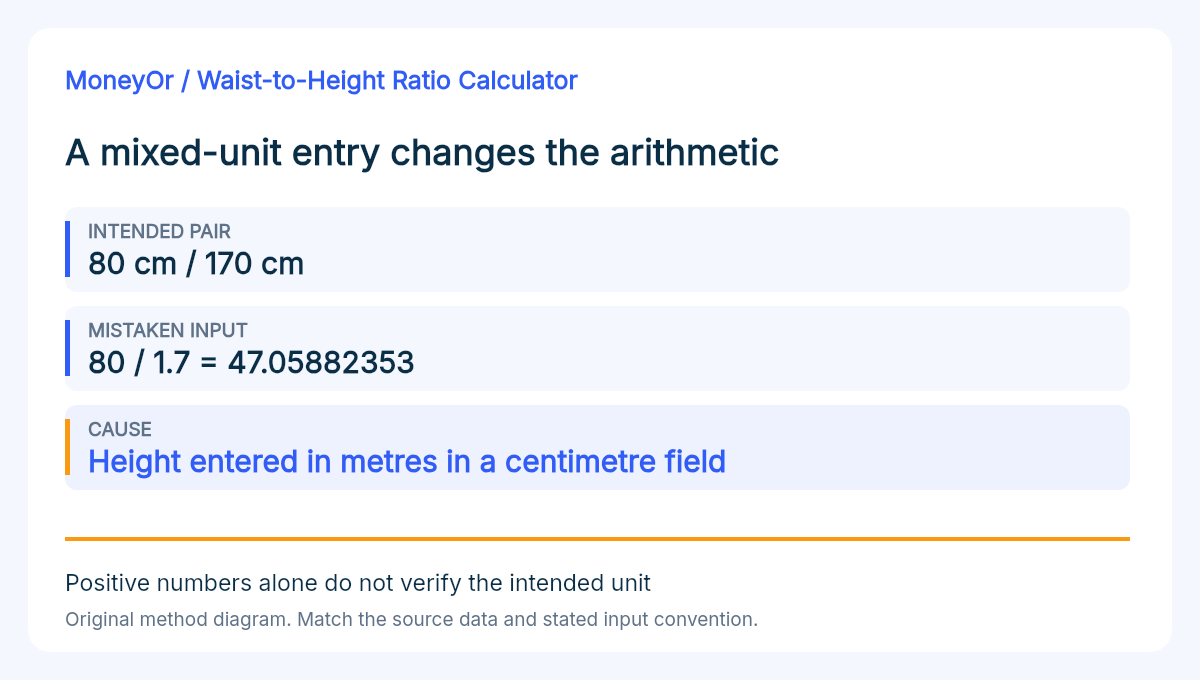
Enter a numerical value without the unit abbreviation. A height of 1.7 metres should be entered as 170 centimetres, not 1.7. The labels define what the fields mean; the Waist-to-Height Ratio Calculator does not infer a unit from the size of the number.
Both values must be positive and finite. A blank field, zero height or negative circumference is rejected. A positive input that passes numerical validation is not automatically a plausible or suitable human measurement.
Keep decimal precision that actually exists in the source measurement. Typing extra zeros or additional guessed digits does not make a tape reading more accurate. Record the source values if someone else will need to reproduce the calculation.
Waist-to-Height Ratio Calculator waist divided by height
The formula is waist-to-height ratio = waist circumference / height. No squaring or multiplication by 100 is required for the ratio itself. Because the two measurements use the same length unit, that unit cancels in the division.
For the default example, 80 / 170 = 8 / 17, which is about 0.47058824. The displayed number is a rounded decimal representation of that fraction. It should not be relabelled as kilograms, centimetres or a percentage of body fat.
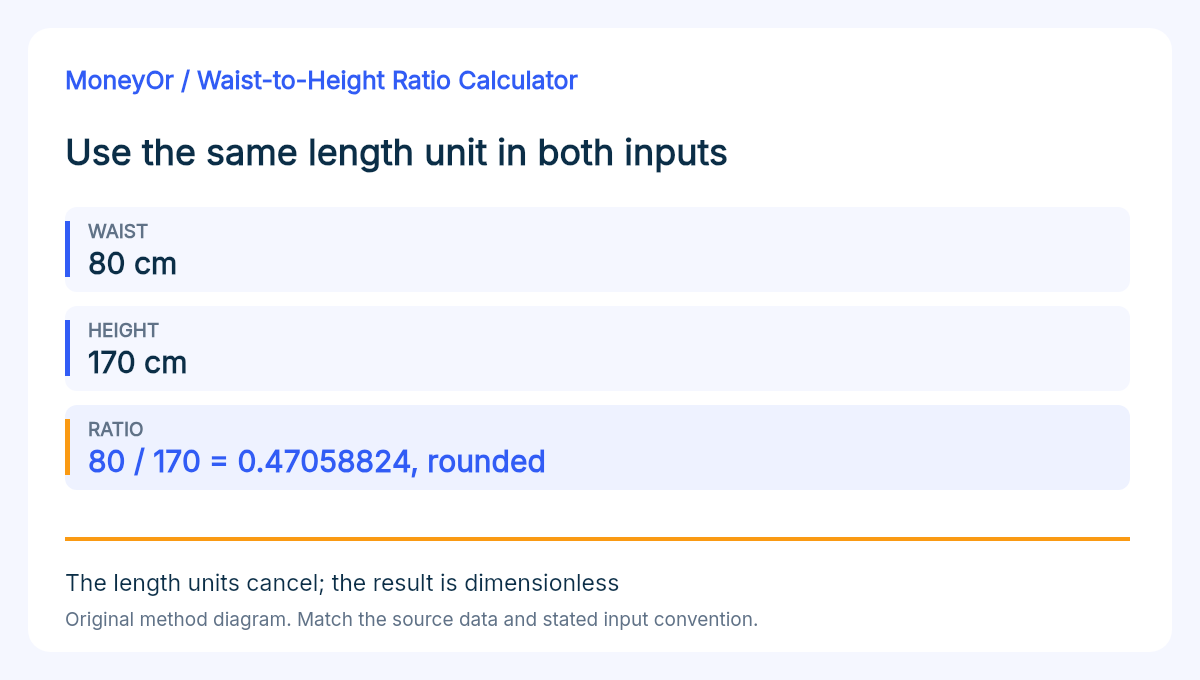
The same mathematical ratio would result if both measurements were converted consistently to another common length unit. However, the Waist-to-Height Ratio Calculator is labelled in centimetres. Entering one value in metres and the other in centimetres creates a unit mismatch that the division cannot detect.
Height is used once in the denominator. This differs from BMI, which squares height after converting it to metres. Copying the BMI formula into a waist-to-height question would therefore answer a different numerical problem.
If you express the ratio as a percentage of height, multiply it by 100 and label that quantity clearly. That is only a different expression of the same length relationship. The Percentage Calculator can help with a separate percentage-of-total calculation.
A mixed-unit entry illustrates the error clearly. Entering 80 and 1.7 returns about 47.05882353, while 80 and 170 returns about 0.47058824. Both pairs contain positive numbers, so a numerical parser cannot infer which measurement you intended. The first result is one hundred times the second because its denominator is one hundred times smaller.
Waist-to-Height Ratio Calculator unit consistency checks
A convenient first check uses 90 centimetres divided by 180 centimetres. The result is exactly 0.5 because the first measurement is half the second. It is an arithmetic example, not a recommendation for an individual.
| Waist circumference | Height | Ratio |
|---|---|---|
| 80 cm | 170 cm | 0.47058824, rounded |
| 90 cm | 180 cm | 0.5 |
| 100 cm | 160 cm | 0.625 |
| 72 cm | 180 cm | 0.4 |
| 80.5 cm | 175 cm | 0.46 |
These values were checked against the actual engine using independent expected ratios. The table deliberately contains different numerical relationships. It is not a table of approved waist sizes, treatment targets or health outcomes.
A reverse check multiplies the ratio by height. In the final row, 0.46 × 175 = 80.5, recovering the circumference. With a repeating decimal, use the original fraction or allow for rounding when multiplying the displayed result back.
Swapping the inputs changes the calculation. The waist belongs in the numerator and height in the denominator. The Waist-to-Height Ratio Calculator does not automatically reorder them based on which number is larger.
Keep the paired measurements together. A copied result such as 0.46 cannot tell another reader whether the inputs were correct or how they were measured. The original values provide the evidence needed to reproduce the numerical result.
How much does the measurement method matter?
The calculation can only use the numbers supplied. A different tape position, a different height reading or a transcription error changes the result. Correct division does not compensate for an inconsistent source measurement.
Follow an appropriate health-service or professional measurement method rather than choosing a convenient location solely because it produces a preferred number. The NHS waist-to-height calculator, checked in 2026, provides measurement guidance within its own assessment workflow.
This MoneyOr tool does not inspect tape placement, posture, clothing or the source equipment. It has no camera, connected measuring device or automatic check that two readings were obtained in the same way.
For a record intended to be compared later, note the measurement method and date alongside the values. If the method changes, a difference in the ratio may partly reflect that change rather than a like-for-like difference in the underlying measurements.
If measuring or interpreting the result is inappropriate or uncertain in your situation, use qualified guidance rather than repeatedly adjusting inputs until a desired number appears. The Waist-to-Height Ratio Calculator's numerical acceptance is not a judgement about the suitability of self-assessment.
For a controlled sensitivity example, keep waist at 85 centimetres. Height 170 centimetres gives 0.5, while height 171 centimetres gives about 0.49707602. The arithmetic has changed because the height input changed. This is not evidence that typing a different height altered anyone's health. It shows why the original measurement, its method and its precision belong with a result. These numerical examples do not prescribe how often someone should measure themselves or replace guidance on an appropriate assessment.
What does the half-height reference mean?
Mathematically, a waist circumference equal to half the height gives a ratio of 0.5. Values below or above that reference describe whether the entered circumference is less or greater than half the entered height.
The NHS page, reviewed in 2025 and checked here in 2026, gives general half-height guidance and says its calculator must not be used to diagnose a condition. It also lists situations in which its assessment should not be used. Read that guidance in its original context rather than treating a single ratio as universally applicable.
The MoneyOr result does not print a pass/fail health label. It does not check age, pregnancy, relevant conditions or whether another measurement makes a particular assessment unsuitable. Those missing checks should not be mistaken for clearance to interpret every accepted input clinically.
A ratio below a reference does not establish that every other aspect of health is satisfactory. Equally, a ratio above it does not diagnose a disease or prescribe an intervention. Those are different questions from the division performed by the Waist-to-Height Ratio Calculator.
This page provides educational numerical information, not personal medical advice. If you are concerned about a measurement or do not know whether the screening approach is suitable, ask an appropriate health professional for individual guidance.
How does this differ from BMI, BMI prime or a waist-to-hip ratio?
Waist-to-height ratio uses waist circumference divided by height. BMI uses weight divided by squared height. The BMI Prime Calculator then rescales BMI using its stated reference. These formulas use different quantities and their numerical outputs are not interchangeable.
The Waist-to-Height Ratio Calculator does not ask for hip circumference, so it does not calculate a waist-to-hip ratio. A waist-to-hip result from another source cannot be pasted into the waist field as though it were a circumference.
Likewise, weight is not one of the Waist-to-Height Ratio Calculator's inputs. Changing a weight entry in another calculator does not change the waist-to-height result unless the measurements entered here also change. The tool has no shared health profile across pages.
Different screening measurements can offer different information, but combining several calculator outputs does not automatically create a diagnosis. Each result retains the limitations of its inputs and method.
Choose the Waist-to-Height Ratio Calculator that matches the actual question and keep the output label attached to the number. A dimensionless ratio, a BMI value and a body-fat percentage may look like ordinary decimal numbers while representing very different concepts.
Why might my result differ from another calculation?
Start by comparing the exact inputs and units. A rounded height, a different circumference reading or an accidental input reversal can explain a difference before any formula issue is involved.
The result display uses at most eight decimal places and ordinary browser floating-point arithmetic. A tiny last-digit difference is not evidence that the source measurements support that level of precision. Keep the original readings instead of chaining rounded results through further calculations.
There is no clinical plausibility classifier. The engine can calculate a ratio from positive numerical inputs even if those numbers were entered in the wrong unit or do not describe a realistic measurement. It rejects an output that exceeds its finite numerical range.
Copy result, Save as baseline and Download CSV can retain or compare the displayed result during the current page session. They do not create a complete health record or keep a permanent history of measurement dates and methods. Save the original inputs separately when they matter.
The inspected arithmetic processes the entered values in the browser. It does not retrieve medical records or verify a person's identity. The MoneyOr privacy policy describes the website's wider delivery and analytics practices separately from this calculation.
Frequently asked questions
Is the ratio the same as body-fat percentage?
No. It is the circumference divided by height. A result of 0.46 means the entered circumference is 46 percent of the entered height, not that body fat is 46 percent. The Waist-to-Height Ratio Calculator contains no direct body-composition measurement.
Can I enter waist in inches and height in centimetres?
No. The measurements need a common unit, and this form labels both fields in centimetres. Convert the source values before entering them. The calculator does not identify or correct a mixed-unit input merely because the resulting ratio looks unusual.
Does the form assign a healthy or unhealthy category?
No. The current result is a numerical ratio without a risk category or health pass/fail label. Its acceptance of the input does not establish that the screening method is appropriate or that the resulting number diagnoses an individual.
Why is weight not required?
Weight does not appear in the waist-circumference-divided-by-height formula. It is needed for other calculations such as BMI. Adding an unrelated weight value to one of these fields would change the question rather than improve this ratio.
Can different people have the same ratio?
Yes. Different circumference-and-height pairs can have the same quotient. For example, 85 divided by 170 and 90 divided by 180 both equal 0.5. Equal ratios do not establish identical body composition, health history or individual needs.
Does changing centimetres to metres change the ratio?
Not if both measurements are converted consistently before division. The common factor cancels. This particular form still labels its inputs in centimetres, so use those stated units to keep the input record clear and reproducible.
Do I need to register or enter identifying information?
No tool account is required, and the numerical form does not ask for a name or medical history. Enter only the measurements needed for the calculation. Refer to the privacy policy for wider website practices rather than assuming the arithmetic describes every site process.
Will the tool recommend a target waist size?
No. It returns the ratio supplied by the two measurements. The worked examples are arithmetic checks, not personal targets. A suitable health goal or a concern about a measurement needs appropriate individual advice beyond this form.
Sources and method notes
- NHS, Calculate your waist to height ratio. Retrieved 2026-11-15.