Force Converter
Try Force Converter
Loading calculator. If this message stays visible, enable JavaScript and reload.
Your result
The force converter expresses a known force in newtons, kilonewtons or pounds-force. Enter the value, select its original unit and choose a target. For example, 3.5 kN is 3,500 N, and 45 lbf is approximately 200.16997269 N.
Check the quantity on the original label before entering the amount. A reading in pounds-force describes force. A value in pounds or kilograms can describe mass and needs a separate physical relationship to yield force. A signed load also has a direction convention that belongs beside the answer after conversion.
On this page
- Force Converter supported force units
- Force Converter signed load inputs
- Force Converter newton-based factor formula
- Force Converter worked unit-direction checks
- How do mass, weight and applied force differ?
- Why are pressure and torque separate quantities?
- What details should stay with a converted measurement?
- How do you copy, export or compare force results?
- Frequently asked questions
- Sources
How to use the Force Converter
Force Converter supported force units
The force converter offers N, kN and lbf in both unit menus. N stands for newtons, kN for kilonewtons and lbf for pound-force. The selections work in either direction, so the same form can convert lbf to N or N to lbf.
A newton is the unit associated with kilograms times metres per second squared. One kilonewton has one thousand newtons. Pound-force belongs to a different unit convention. The Force Converter uses approximately 4.44822161526 N for one lbf, consistent with the pound-force relationship tabulated by NIST at its stated precision.
Read the full label on a drawing or test report. An instrument may print a force in kN while an adjacent column gives stress or pressure. A value reported in N per square millimetre has an area denominator. Enter only a force from the relevant row. The selectors represent force as a standalone quantity.
The Force Converter menu does not include kilogram-force, ounce-force, dynes or kips. If a source explicitly uses one of them, first verify the appropriate relation from a reference and express the force in a supported unit. For a figure in kips under the convention of 1,000 lbf per kip, handle that multiplication before entering the number as lbf.
If a record says only pounds, check whether it refers to mass or force. Confirm the original meaning from the specification or the person who recorded it before attaching the lbf label.
Force Converter signed load inputs
Type the numeric value into Amount. Match From unit to the input measurement and choose the desired target under To unit. Choose Calculate / Run and check both the output label and the line that shows the factor for one source unit.
For a pull recorded as 45 lbf, use Amount 45 and select lbf to N. The answer is approximately 200.16997269 N. For a positive source amount, changing from lbf to N increases the numeric count, because a newton is the smaller unit.

If a test defines tension as positive and compression as negative, keep that sign when entering the relevant component. For example, -0.25 kN becomes -250 N. A test report can use the opposite convention. Record the applicable convention beside the source and converted amounts.
Use a decimal point for a fraction and omit any unit symbol or grouping commas from Amount. Enter 0 explicitly for a zero reading. For a scale check, choose the same unit in both menus. The factor is one, and the amount appears with the ordinary result formatting.
The Force Converter processes one number at a time. Convert each item separately for a force table. Check the input and selectors before copying so a reading from a previous row is not accidentally paired with the new unit.
Force Converter newton-based factor formula
Multiply the source amount by the number of newtons per source unit, then divide by the number of newtons per target unit. With N as the common scale, the unit factors are 1 for N, 1,000 for kN and approximately 4.44822161526 for lbf.
| Unit | Newtons in one unit | Direct check |
|---|---|---|
| N | 1 | 1 N = 0.001 kN |
| kN | 1,000 | 1 kN = 1,000 N |
| lbf | Approximately 4.44822161526 | 1 lbf ≈ 0.00444822162 kN |
For a conversion from 550 lbf to kN, multiply 550 by approximately 4.44822161526 and divide by 1,000. The result displays as 2.44652189 kN. For the reverse direction, multiply a kN input by 1,000 and divide by the newtons-per-pound-force factor.
The Force Converter result and one-unit factor are each rounded for display. In this example, multiplying a rounded lbf-to-kN factor can differ slightly in the final digits from a conversion made with the stored constants. Use the original unit factors at a suitable precision for later calculations.
The basic calculator gives a way to check an expression that includes a separately supplied force factor. Set each multiplier and divisor explicitly. The unit path is easiest to verify when you write the newton scale on the intermediate value.
Force Converter worked unit-direction checks
Try the following checks as independent runs. The examples use a small amount, a typical lbf-to-newton conversion and a negative component. The abbreviated unit attached to the answer is part of the expected result.
| Input | Target | Result | Reasonableness check |
|---|---|---|---|
| 3.5 kN | N | 3,500 N | Scale increases by 1,000 |
| 100 N | lbf | 22.48089431 lbf | Divide by more than four |
| 45 lbf | N | 200.16997269 N | Multiply by about 4.45 |
| 550 lbf | kN | 2.44652189 kN | Convert to N then divide by 1,000 |
| -0.25 kN | N | -250 N | Positive factor retains the sign |
| 10 N | kN | 0.01 kN | Divide by 1,000 |
| 0 lbf | kN | 0 kN | Zero remains zero |
For a test report with force channels in both lbf and kN, decide on one target scale before converting individual readings. A comparison of the raw numbers 550 and 2.5 says little while the units differ. After converting 550 lbf to about 2.4465 kN, you can compare it directly with a 2.5 kN reading measured on the same basis.
Account for the source instrument’s precision if you need to describe a difference. The many digits in a computed conversion do not tell you how precise either original measurement was.
How do mass, weight and applied force differ?
Mass describes how much inertia a body has. Weight, in a physics problem, is the gravitational force on the body. The unit symbol kg describes mass, while N and lbf describe force. A reading labelled kg can stay on the mass scale unless the question explicitly asks for a gravitational force.
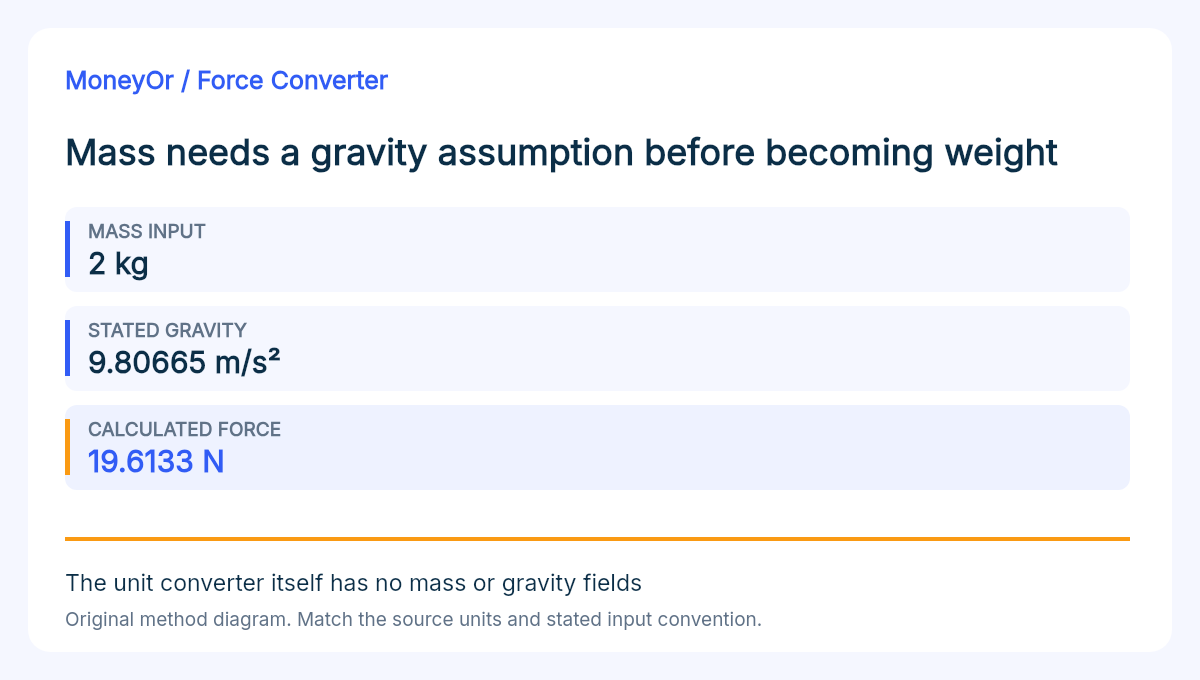
To compute weight in a simple model, multiply the mass by the gravitational acceleration specified for the problem. For a mass of 2 kg using conventional standard gravity of 9.80665 m/s², the calculated weight magnitude is 19.6133 N. If that force is the intended input, enter 19.6133 and select N.
The mass converter can express an existing mass in compatible units first. The acceleration converter expresses a given acceleration in m/s², ft/s² or multiples of standard gravity. Choose the unit appropriate to each part before doing a separate calculation.
For net force in a motion problem, OpenStax explains Newton’s second law as the relationship between mass, acceleration and the total external force. The calculated net force can differ from one applied force where several act together. Identify what the labelled reading represents before converting it.
The Force Converter has no mass, gravity or acceleration fields. Its answer uses the force you provide and does not infer how it was obtained. Keep that distinction in lab notes and equipment comparisons.
Why are pressure and torque separate quantities?
Pressure relates force to area. To find pressure from a force, also obtain the relevant area. For a simple case with a uniform perpendicular load of 100 N over 0.01 m², the average pressure is 10,000 Pa. The division is a separate calculation. Use the pressure converter once you have a pressure value and know its unit.
Torque describes the turning effect of a force about an axis. The moment arm and force direction determine how much torque the same force produces. For a perpendicular force of 100 N applied 0.2 m from the axis, the torque magnitude is 20 N·m. The torque unit converter scales a torque already found this way or measured directly.
Notice the unit differences. Pressure includes area in the denominator. Torque includes length as a multiplier. Force has no trailing length or area term. A load column beside a pressure or torque column in a report can share some unit symbols while describing a different quantity.
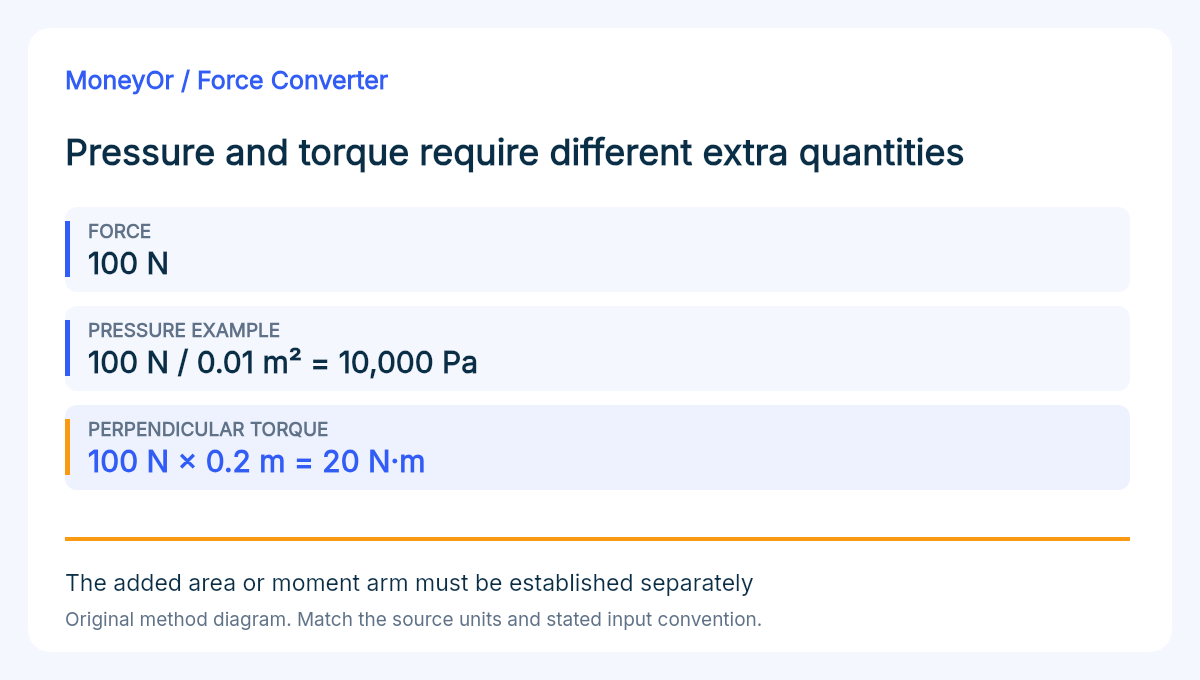
If a question gives a force and asks for stress, pressure or torque, annotate the intermediate force unit after converting and carry the remaining quantity through the equation. Then check the dimension of the final answer against what the question requested.
Area and lever arm describe different aspects of a setup. For example, a drawing may indicate the surface over which a load is spread and also show how far that load acts from a hinge. Use the surface area for the pressure calculation. Use the moment arm relative to the hinge for a turning-effect calculation. The same list of dimensions can yield two distinct answers.
What details should stay with a converted measurement?
Keep the source measurement point and axis convention. A report can show loads at different parts of a system, or it can use the same force unit for separate directions of a measurement. A conversion scales a component, leaving those identifiers for you to record.
When working with axes, convert each component on its own using the same unit pair. The axis convention determines whether a load is positive or negative. If a worksheet needs a vector magnitude, compute it using compatible component units and the geometry specified by the problem.
When comparing force values, check whether each amount is a measured load, an estimate, a peak, an average or a specification. Identical unit labels make the scales compatible. The extra measurement context makes the comparison meaningful.
The display has up to eight decimal places. A tiny value on a large target scale can be rounded to zero, while an ordinary measured load can show more decimals than the input justifies. Use a smaller target unit if you need a readable small result, and set precision from the source when reporting a measurement.
Retain an original record for later verification. A converted number can usually be traced back using the same factors, but a heavily rounded answer may no longer recover the source exactly.
For a specification with a nominal force and a tolerance, convert the tolerance as its own force magnitude when it is given in the same units. If the tolerance is written as a percentage of the nominal value, keep that percentage with the record because unit conversion rescales the nominal value and its corresponding absolute tolerance by the same factor.
How do you copy, export or compare force results?
Copy result transfers the answer and its factor detail. Download CSV provides a file containing the result and its displayed details. Save the source amount, unit and measurement annotations in your own worksheet beside that export. The conversion does not attach axis names or instrument data.
Save as baseline holds the answer during the current page session. Choose a shared target unit before comparing a subsequent reading against it. A baseline in newtons and a fresh answer in kilonewtons need to be brought onto one scale before the difference is useful. Reset fields clears the current result and saved baseline.
If you import the value into a calculation sheet, keep a numeric column and a unit column or use a consistent unit in the heading. Confirm the amount is read as a numeric cell. That check is particularly useful for large grouped numbers and signed values.
The browser calculation needs only the amount and unit options. A whole test report, equipment identity or measurement history is unnecessary. Record the conversion alongside the rest of the report using the document format required for that work.
Before distributing a figure, replay one conversion in reverse or apply a simple magnitude check. Use the original reading for the check and account for rounding on copies.
Frequently asked questions
What is one kilonewton in newtons?
One kilonewton equals 1,000 newtons. In the Force Converter, enter 1, choose kN as the source and N as the target. The relationship is exact.
Is lbf a unit of mass?
Lbf denotes pound-force. A pound used as a mass unit describes a different physical quantity. Check the source and calculate a force separately if you were given only mass.
Can I enter a value reported in psi?
Psi measures pressure in pounds-force per square inch. You need the relevant area to infer a force. For direct pressure unit changes, use the pressure converter.
Does a negative force always mean compression?
The meaning depends on the convention. Some reports use a negative sign for compression and others define the opposite. Keep the convention with the converted reading.
Can this calculate a combined force from different directions?
The Force Converter changes the unit of one amount per run. To combine forces, first express components in compatible units and apply the appropriate vector arithmetic separately.
Why does the displayed factor sometimes differ in the last places?
The factor line and result use rounding for display. Use the documented factors and original amount for an independent calculation when the final digits matter.
Sources
- NIST: Guide to the SI, Appendix B.9 Factors by Kind of Quantity. Reference checked 26 November 2026.
- OpenStax: University Physics Volume 1, 5.3 Newton’s Second Law. Reference checked 26 November 2026.
- OpenStax: University Physics Volume 1, 10.6 Torque. Reference checked 26 November 2026.